
A founder walked out of Nvidia, a single router grounded American aviation, and Anthropic told investors that its hardest problem is buying enough chips. Our view: the story of the week was not artificial intelligence but the things it stands on, and markets are still worrying about the wrong ones.
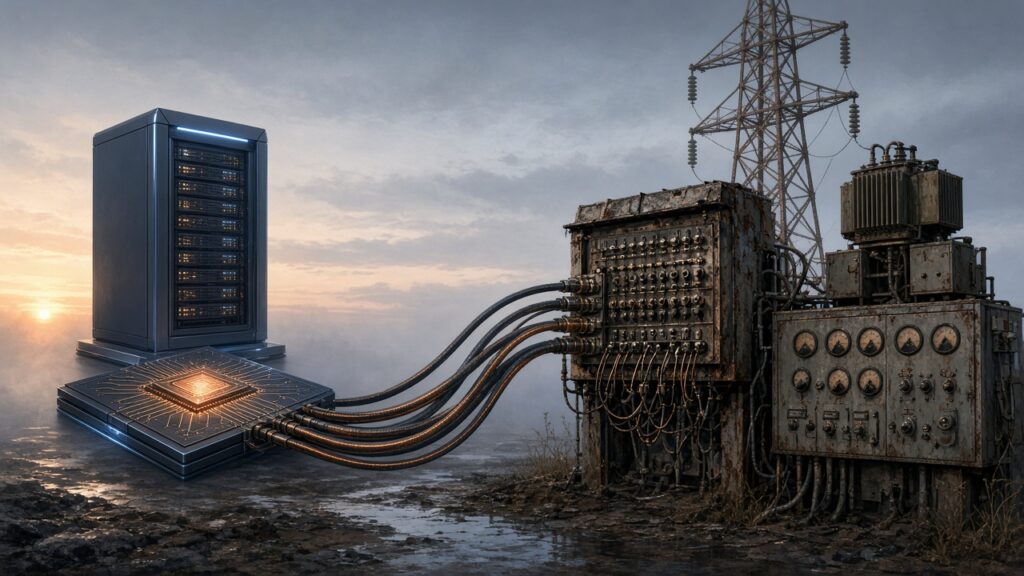
Every so often a week arrives that tells you more about an industry than a year of product launches. This was one. On the surface it was a week of AI headlines: a chief executive gone, the largest share sale in history lining up, new chips, a shopping wallet for software agents. Underneath, almost every one of those stories turned on something unglamorous. People. Capital. Factories. Electricity. Copper wire. This editorial sets out what happened, then says plainly what we think it means. Where we are offering opinion or forecast, we say so.
What happened at Nvidia, and what it does not mean
The facts first. Nvidia’s board accepted Jensen Huang’s resignation as president, chief executive and director on 11 November, and the company announced it on 12 November. Colette Kress, finance chief since 2013, is interim chief executive while remaining chief financial officer, and the long-serving director Harvey Jones becomes the company’s first board chair. Reuters reported that Huang left after revelations of extramarital affairs, including one involving a woman suspected of being a Chinese spy. Nvidia’s quarterly results are scheduled for Tuesday 17 November, Kress’s first outing in the role.
The analysts’ verdicts arrived quickly and were broadly consistent. KeyBanc’s John Vinh, who downgraded the shares, called the departure “a material increase in strategic, organizational, and execution risk”. Nathan Thooft, chief investment officer at Manulife Investment Management, told CNBC that Nvidia still has deep benches of people who can carry out existing plans, but that “the bigger risk is the foresight in the next several years”. Shay Boloor of Futurum Equities made the same split in comments reported by Reuters: “I don’t see the next 12 to 18 months of revenue suddenly disappearing if Jensen were to leave,” he said, adding, “My bigger concern is next decade.”
Our view. The near-term panic about AI demand is overdone, and the analysts above largely agree. Nvidia’s order book does not resign with its founder. What deserves far more attention is a quieter detail in the coverage: how much of the AI economy has been financed by Nvidia itself.
Reuters reported, citing people familiar with the matter, that Kress and her staff clashed with Huang over large financing deals with Nvidia’s own customers, and that a proposed $250 billion plan to support an OpenAI data centre project in Ohio was pared to $120 billion. A venture investor told the agency: “I think it’s unlikely anyone but Jensen is going to invest in his own customers as aggressively.” Jun Bei Liu of Ten Cap in Sydney put the market’s anxiety more bluntly to Reuters: “I think the fear is that the music might stop.”
That is the real key-person risk, and it is not about chip design. A supplier lending, investing and guaranteeing its way into its customers’ balance sheets creates demand that looks organic until the lender changes its mind. If a more cautious Nvidia lends less, some of the boom’s weaker borrowers will have to prove their economics on their own. We think that would be healthy, not a disaster. An industry that only works while one company subsidises it is not yet an industry.
Anthropic’s most important sentence was an admission
The second major story of the week was the launch of Anthropic’s roadshow on 10 November: 825 million shares at $70 to $78, listing on Nasdaq as ANT. TechCrunch calculated a fully diluted valuation of up to $1.404 trillion at the top of the range, against $965 billion in a private round in May, and CNBC reported that pricing is planned for 18 November with trading on 19 November.
On Friday, in a livestreamed conversation with JPMorgan’s Jamie Dimon, Dario Amodei said: “Compute is the deepest business dilemma that the company faces.” Buy too little capacity a year or two ahead and you cannot serve customers; buy too much and, in his words, “you can financially overextend yourself.” He said Anthropic tends to “buy on the low side” and wants to “underpromise and overdeliver.” According to Bloomberg’s account of the latest filing, the company’s commitments, mostly for computing power, now stand at nearly $901 billion, with about $71 billion due in the year to September 2027.
Renaissance Capital, which follows IPOs closely, notes two things worth keeping beside the valuation: sequential revenue growth slowed to 47 per cent in the third quarter from 144 per cent in the second, and the top five customers accounted for 21 per cent of third-quarter revenue.
Our view. Amodei’s candour is welcome and unusual, and it is the single most useful thing an AI executive said all week. It reframes a frontier AI company for what it is: a business that must buy enormous amounts of physical capacity before it knows what that capacity will earn. That is closer to an airline ordering aircraft or a utility building power stations than to a software company. Readers weighing the listing should think about it on those terms. This is not investment advice, and we take no view on the price.
The planes stopped, and AI was not to blame
On Friday afternoon US Eastern time the Federal Aviation Administration halted departures across the country. The stop ran from about 3.54pm to 8.15pm Eastern, according to AVweb, and Reuters called it the longest shutdown since the September 2001 attacks. FAA Administrator Bryan Bedford said around 12,000 flights did not happen, FedScoop reported.
Three days earlier the FAA had extended SMART, an AI-assisted traffic planning tool built by Air Space Intelligence, to all 22 of its en-route centres. Speculation followed immediately. Transportation Secretary Sean Duffy said SMART is not connected to the core radar and flight-tracking systems, and that “there’s no possible way SMART would have impacted what happened.” On Saturday he gave his account of the cause: a contractor was switching an old copper telecoms line to fibre at a remote site, and a router in that work “started flooding other routers in our air traffic control system” with more than 1,000 connection attempts every four to five seconds. Whether it was a faulty router or installation error, he said, had not been determined. Bedford added, according to FedScoop, that this maintenance was logged manually, so staff had to search paper records to find out who was working where.
Duffy also said something worth remembering: “Maybe the FAA is the last one to be doing this work because the investments haven’t been made.” The Washington Post reported that a government watchdog warned in September that the way legacy systems were being replaced could cause disruptions, including ground stops.
Our view. This is the most instructive story of the week for anyone who thinks about technology risk. The public instinct was to blame the new AI system. The cause, on the official account so far, was the oldest possible failure: a copper-to-fibre swap, a misbehaving box, and paper maintenance logs. AI risk is real, but it is frequently overhyped relative to the risk sitting in neglected infrastructure. The newest layer of the stack gets the scrutiny; the oldest layer does the damage.
Chips: the monopoly loosens, the factories do not get easier
Three hardware stories pointed the same way. Google added two variants to its eighth-generation TPU line: TPU 8tx, designed with AMD for confidential training and inference, and TPU 8i Max, which places two inference chips in one package. In Britain, Fractile raised $720 million at a reported valuation of about $7 billion to ship its first inference chips and systems next year. And TSMC reported record October revenue of NT$586.89 billion, up 59.7 per cent on a year earlier.
The counterweight came from Japan. Bloomberg reported that Rapidus, the state-backed effort to make 2-nanometre chips at home, has not yet produced functioning SRAM cells, a milestone it needed by the summer, leaving it at least months behind its March 2028 target. The company says it remains committed to that date.
Our view. Demand for AI silicon is now broad enough that buyers can design around a single supplier, and that is a structural shift that will outlast this week’s drama. But diversity of chip designers is not diversity of manufacturing. Most of the world’s leading AI chips are still manufactured by one foundry, TSMC. Rapidus is a reminder that money and political will do not buy process yield on a timetable. We expect the manufacturing bottleneck, not the design bottleneck, to set the pace through the rest of the decade.
Power is the binding constraint, and inventors know it
Infineon’s full-year results on 10 November made the point in numbers. The German chipmaker forecast revenue of about €20 billion for its 2027 financial year, with power supplies for data centres alone approaching €4 billion. On 12 November Australia’s energy rule maker published new connection rules for large data centres, setting a 30 megawatt threshold and requiring large loads to ride through grid disturbances rather than drop off. It cited 1,500 megawatts of simultaneous disconnections in Virginia in July 2024. The commission’s chair, Anna Collyer, said: “Our guiding principle is that once a customer is big enough to materially affect the grid, it must be treated as part of that grid.” The same day, a report from the insurance broker Howden, covered by Energy Live News, estimated that US data centre power demand has grown 19 per cent a year since 2020, ten times faster than grid capacity. Deborah Duss of Howden said: “The data centre boom is shining a spotlight on an infrastructure challenge that has been building for years.”
This is where our own coverage sat all week, and it was not planned that way. Infineon also said this week that it has processed 300mm silicon carbide wafers into working power devices, without yet publishing yields. A Hong Kong team showed a gallium oxide module switching a megawatt in pulses. Diamond Foundry grew a 200mm single-crystal diamond aimed at pulling heat out of chips. On the grid side, KAUST’s reflective coating for power lines promises more current from existing wires, and a German study made the case for iron powder as a seasonal energy store.
Hydrogen work, which feeds the same energy system, kept coming: Barcelona’s chromium-protected ruthenium catalyst, a Latvian membrane-free electrolyser patent, EPFL’s wireless solar water-splitting sheet and an Australian electrolyser that runs on waste heat. UCL’s iodine water battery and DGIST’s magnets with four-fifths less dysprosium attack the materials side, as does machine learning that designs iron from dirty scrap.
Our view. If you want to know where AI is going, watch the power electronics, the cooling and the grid connection queue, not the chatbot leaderboards. Most of the inventions above are at laboratory or demonstration stage, and we said so in each story. But they are aimed squarely at the constraint the industry’s leaders are now describing in public. We would rather back the humble switch and the better cable than another model announcement.
Agents get a wallet, with a sensible leash
OpenAI launched ChatGPT Wallet on 13 November. TechCrunch reports it lets OpenAI’s agents complete purchases for eligible US ChatGPT Pro subscribers, with each purchase reviewed and approved by the user, and tokenised card details so neither agent nor merchant sees the real card number.
Our view. The design is more important than the launch. A human approval on every purchase is the right default, and the industry should resist the temptation to remove it quickly. Agentic commerce is being sold as a revolution; for now it is a convenient checkout with a well-designed safety catch. That is fine. Trust in software that spends money will be earned in years, not quarters.
Meanwhile, in the slow lane
Biology does not run on the AI calendar. This week we covered a Cambridge approach that got adult heart muscle dividing again in mice, a Belgian enzyme that strips the clot shell from a superbug, a drug that corrected a splicing error in motor neuron disease in the lab, and a therapy that silences hepatitis B rather than cutting it out. Each is promising. Each is years from patients, and some will fail. Elsewhere, Imperial’s folding analogue-to-digital converter, Kyoto’s terahertz link from a moving car and ETH Zurich’s adhesive made from plastic bags showed how much invention still happens far from the AI spotlight.
Our view. These are the stories most likely to be underpriced by attention, precisely because they move slowly. Investors and readers who only follow the fastest news cycle will miss the decade-long compounding that happens in labs.
What the week says about the future
Here is our forecast, and it is opinion. The AI era is entering a phase in which the scarce resources are physical and institutional rather than algorithmic: electricity, grid connections, foundry capacity, competent maintenance, and balance sheets willing to fund all of it before the revenue arrives. The winners of the next five years are as likely to be the companies that make power devices, cooling, cables and electrolysers as the companies that train models. Governance will matter more, not less, because the industry has concentrated so much in so few people and suppliers.
We also think the story of AI risk is being told backwards. The week’s genuine failures came from old infrastructure and from concentration of influence in one person, not from runaway software. If there is a single lesson for anyone allocating money or attention, it is to look one layer down. The model is what everyone watches. The foundations are what decide.
This is an editorial and reflects Crazyhombres’ opinion. Facts and quotations are attributed to the linked sources. Nothing here is investment advice.