
ProtiumTech, a spin-out of Riga Technical University research, has a European patent application published for a two-cell electrolyser that makes hydrogen and oxygen in separate cells without a membrane, using tungsten oxide electrodes that store protons and swap roles. The design is real and published. The company’s efficiency claims are not independently tested and do not all agree with each other.
The European patent application published on 11 November under number EP 4 837 994 names a single inventor, Martins Vanags, and gives his home as Baldone, a small town south of Riga. The applicant, SIA ProtiumTech, is registered in the municipality of Ogre, further up the Daugava. It is a long way from the industrial centres where most of the world’s electrolysers are designed, and the idea it describes is an attempt to throw out the one part almost every electrolyser shares: the membrane.
What the patent covers
Conventional water electrolysers make hydrogen at one electrode and oxygen at the other at the same moment, so a membrane or separator has to keep the two gases from mixing. In proton exchange membrane designs that barrier is a fluoropolymer, part of the family of chemicals caught up in the EU’s proposed restriction on PFAS. ProtiumTech’s approach, known as decoupled electrolysis, separates the two reactions in time instead of in space.
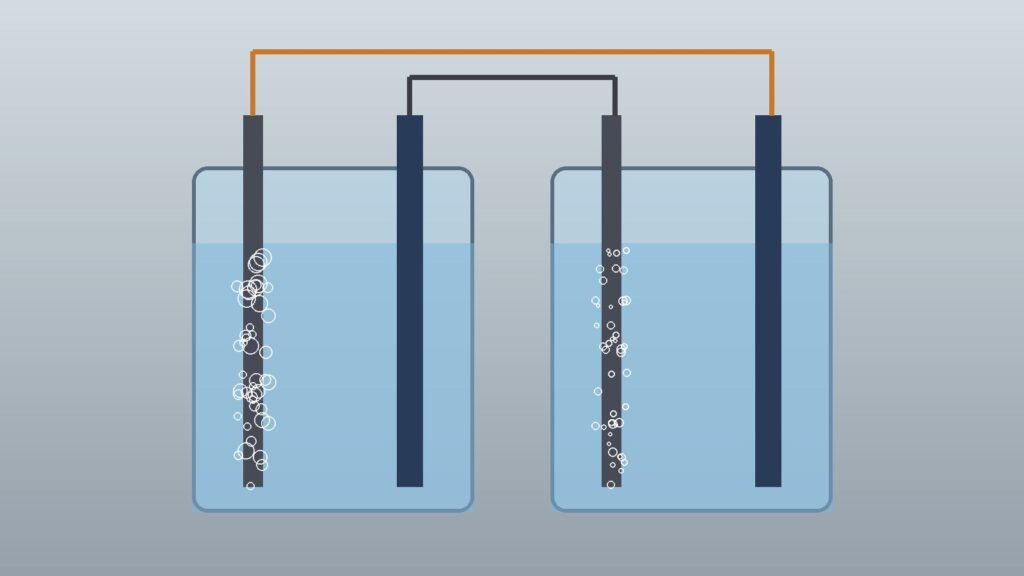
Each cell holds an ordinary gas electrode and a solid redox electrode based on tungsten oxide, in an acidic electrolyte. In one phase, oxygen bubbles off the gas electrode while protons are pushed into the tungsten oxide, which stores them in its crystal lattice. In the next phase the polarity is reversed: the stored protons come back out and hydrogen bubbles off the same gas electrode. Because only one gas is produced at a time, no membrane is needed.
The weakness of a single decoupled cell is that it makes hydrogen only half the time. The new filing, made on 5 May 2025, joins two such cells. Their redox electrodes are wired to each other and the power supply sits across the two gas electrodes. During the first period cell one makes hydrogen while cell two makes oxygen; then the voltage flips and they swap. A gas management system collects hydrogen from whichever cell is producing it. The result, as claimed, is a membrane-free system that makes both gases continuously.
Where it comes from
Decoupled electrolysis is not new as a concept. Chemists at the University of Glasgow showed a liquid-mediator version in 2013, and the Technion in Israel developed a thermally assisted variant commercialised by H2Pro. ProtiumTech grew out of research at Riga Technical University and was founded in about 2023 by Alens Martini, Andris Sutka, Reinis Druna and Vanags, according to Latvia’s Investment and Development Agency, LIAA. It has passed through Estonia’s Beamline accelerator, won investment prizes worth 160,000 euros at Riga’s TechChill contest and, in November 2025, became the only Baltic company picked from nearly 200 applicants for the Fundacion Repsol Entrepreneurs Fund, which brings 120,000 euros and the chance of a pilot with Repsol. LIAA said then that a 5 kilowatt prototype was due by the end of 2025, with 50 kilowatts as the next step.
Why it could matter
Removing the membrane removes one of the costlier and more fragile parts of a stack and lets the system run at room temperature in a simple tank. The two phases also draw different amounts of power. The company says about 70 per cent of the energy goes into the oxygen and charging stage, so an operator could run that stage when electricity is cheap and make hydrogen on demand later. That turns the electrolyser partly into a store, which suits wind and solar. It also says it has redesigned its electrode assembly from 132 components to 10.
Winners if it works would be small and medium hydrogen users who want on-site production without high-pressure storage, and electricity traders who value flexible demand. Membrane suppliers and conventional PEM stack makers would face a cheaper rival in the smaller size classes.
Caveats
The patent shows what ProtiumTech claims as its invention. Publication is not a grant, and the document is a design, not test data. The company’s performance figures come only from its own materials and are not independently verified. They are also hard to reconcile. A co-founder told LIAA the system uses four to five times less energy than normal; the company’s own website quotes 38.8 kilowatt-hours per kilogram of hydrogen for the charging stage, which it says is 70 per cent of the total. That implies roughly 55 kilowatt-hours per kilogram overall, in the same range as today’s commercial electrolysers and well above the thermodynamic minimum of about 39. A separate company post reports an oxygen-cycle efficiency of 110 per cent, a figure that only makes sense as a partial measure. Tungsten oxide electrodes must also survive many thousands of charge cycles in acid, and current density, which sets how much hydrogen a given stack makes, has not been published. No peer-reviewed paper on the two-cell system was found.
Listing check
SIA ProtiumTech is a private Latvian company, not listed. Repsol SA, whose foundation runs the accelerator and which has offered a pilot opportunity, is listed on the Bolsa de Madrid as REP and has a Trading 212 Invest instrument page; Repsol’s involvement is limited to the accelerator programme on the public record, so any exposure is negligible. H2Pro is privately held.