
KAUST researchers have made a retrofit coating that reflects desert sun and draws heat out of a live cable. Modelling suggests up to 18 per cent more daytime capacity in Riyadh, but it has not yet been tried on an operating transmission line.
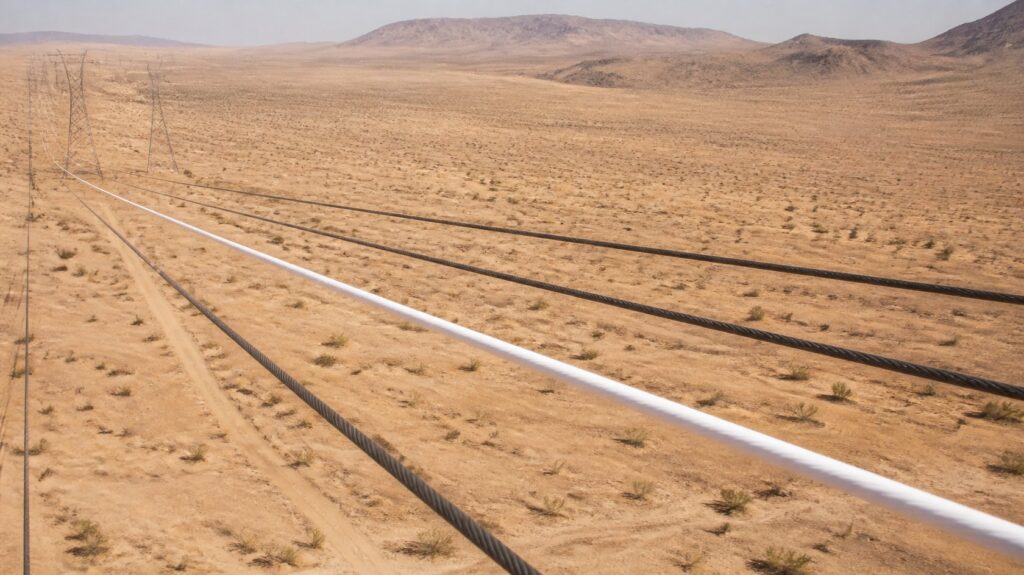
On the shore of the Red Sea at Thuwal, a few lengths of ordinary commercial power cable were laid out in the sun for science. Researchers at King Abdullah University of Science and Technology left some bare, some in conventional insulation and some painted with a pale silicone coating, then watched the thermometers. Around midday the painted cables ran about 5C cooler than the bare ones and about 15C cooler than the insulated ones, according to the university’s account of the work.
That small difference matters because the limiting factor on many overhead lines is not the wire itself but its temperature. A conductor heated by sunshine and by the current it carries sags, ages and eventually exceeds its rated operating temperature, so grid operators cap the current. On the hottest afternoons, when air conditioning drives demand to its peak, lines can carry the least. A coating that keeps cables cooler is, in effect, extra transmission capacity without new towers.
Cooling from outside and from within
Radiative cooling paints are not new. They reflect most sunlight and radiate heat in the infrared band that escapes through the atmosphere, and they have been tested for years on roofs. The KAUST group, led by Qiaoqiang Gan, professor of materials science and applied physics, argues that roofs are the wrong model for a cable. A roof is heated from outside. A cable is also heated from inside by its own resistance, and a conventional cooling paint that insulates the surface can trap that internal heat and make matters worse.
Their answer, described in a paper published online on 8 October in Light: Science and Applications, mixes boron nitride particles into silicone. The particles scatter sunlight, while boron nitride’s high thermal conductivity helps carry internally generated heat out to the surface, where it can be radiated away. The first author is postdoctoral fellow Kai Xu, with contributions from King Abdulaziz City for Science and Technology and Beijing University of Chemical Technology. KAUST’s release followed in early November, and the Saudi Press Agency carried the story.
The results come in three grades of evidence and should be kept apart. Measured outdoors, unpowered commercial cables were cooler when coated. Measured on simulated cables with internal heating under Saudi summer conditions of about 45C ambient, coated samples stayed between roughly 50C and 70C, while bare and insulated samples reached up to 90C and 80C. Durability tests covered 1,000 sandpaper abrasion cycles, 240 hours of accelerated ultraviolet ageing, salt spray and flame. The headline capacity gains, about 10 per cent more current on average during daytime in Riyadh and up to 18.3 per cent in the hottest period, are model projections. Across 13 hot cities the model gave average daytime gains of about six to 10 per cent.
Who gains
If the projections survive contact with real lines, the obvious beneficiaries are transmission owners in hot, fast-growing grids: the Gulf, North Africa, India, Australia and the American south-west. Reconductoring a line with advanced conductors is a capital project that can take years of permitting; painting or wrapping an existing conductor would be an operating expense. The approach sits in the same commercial niche as dynamic line rating sensors, which squeeze extra capacity from existing lines by measuring their real temperature, and the two could be complementary rather than competing.
Makers of silicone and boron nitride powders would gain a new industrial market if the coating scaled. Suppliers of high-temperature, low-sag conductors could see some projects deferred, although a 10 per cent uplift does not substitute for the doubling of capacity those conductors can deliver. Utilities that rely on peaking plant to cover summer constraints might find a cheaper way to keep power flowing.
The caveats
The hardest questions are practical. A coating on a bare overhead conductor must survive decades of wind vibration, ice, dust storms and bird strikes, and it must be applied to energised or briefly de-energised lines by robots or crews working at height. Dust accumulation could erode the solar reflectance that does much of the work. Weight and diameter changes could alter wind loading and sag. None of this has yet been tested on an operating transmission line, a gap the KAUST team acknowledges, and no utility partner or commercial licensee has been named.
There is also a regulatory step. Grid operators set line ratings using standards built around bare conductor behaviour; a coated line would need new rating methods before any operator could legally run more current through it.
Even so, the idea has an unusual commercial logic. It turns the region’s greatest grid handicap, relentless sunshine, into the test condition the product was designed for, and it targets the cheapest megawatt of all: the one that can be pushed through a wire already strung between towers.