
A DGIST team, part-funded by a Korean magnet maker, says a new diffusion recipe delivers comparable magnet performance with 80 per cent less dysprosium. The result is laboratory scale, and large magnets are the next test.
Among the sponsors listed at the foot of a research announcement from Daegu on Tuesday is a name most investors outside Korea would not recognise: Star Group Industrial, known in Korean as Seongrim Cheomdan Saneop. According to the regional daily Kyongbuk Maeil, the company co-funded the work alongside the Daegu Gyeongbuk Institute of Science and Technology and a Kyungpook National University energy research centre. When a magnet manufacturer pays for a laboratory to waste less of its most expensive raw material, the commercial intent is plain.
The material is dysprosium, a heavy rare earth that is added to neodymium-iron-boron magnets so they keep their strength at the high temperatures inside electric vehicle traction motors and wind turbine generators. Supply is concentrated in China, which placed dysprosium and other medium and heavy rare earths under export licensing in 2025. Every gram removed from a motor reduces both cost and exposure.
Putting the dysprosium only where it works
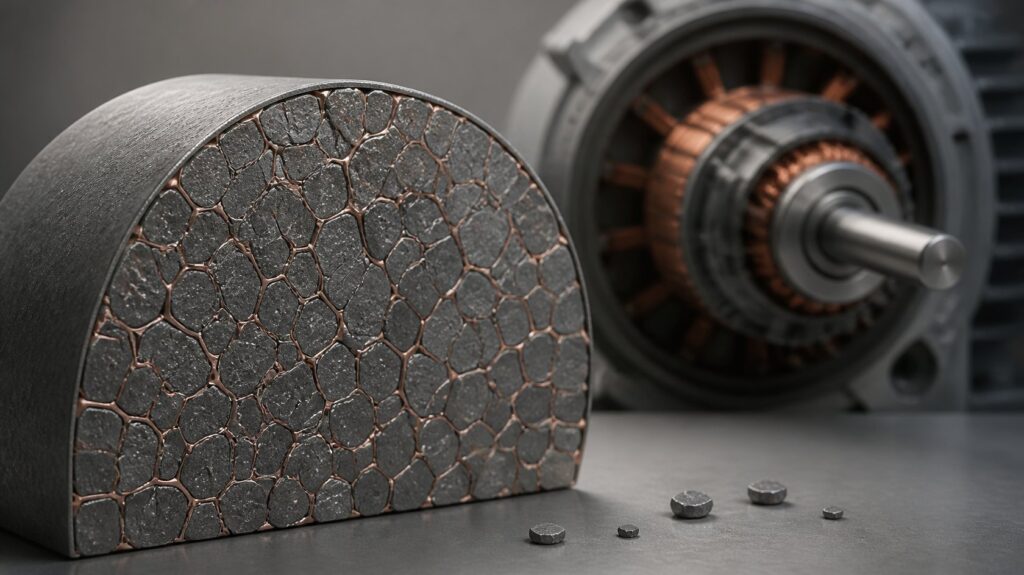
The DGIST team, led by principal researchers Jungmin Kim and Donghwan Kim of the Department of Nanotechnology, worked on a technique already used in industry called grain boundary diffusion. A dysprosium-rich layer is applied to the surface of a sintered magnet and heated, so the element seeps inward along the boundaries between the microscopic grains. Ideally it forms a thin shell around each grain, which is where it raises coercivity, the magnet’s resistance to being demagnetised.
In practice, as the team explains in its release carried by DongA Science, the dysprosium piles up near the surface or soaks into the grain interiors, where it does little good. The researchers designed a new diffusion source that blends dysprosium with lighter, cheaper rare earths, praseodymium and neodymium, plus zinc and copper. The zinc and copper speed diffusion along the boundaries; the light rare earths discourage dysprosium from penetrating the grains. The result is a thinner, more even shell.
Their measurements show dysprosium content in the diffusion source cut by 80 per cent compared with a pure dysprosium source, with comparable room-temperature coercivity and what they describe as excellent high-temperature properties. Elemental mapping confirmed less surface accumulation. The paper, published online in Chemical Engineering Journal on 12 October with Hyeonjong Jeong as first author, lists 16 authors and acknowledges National Research Foundation of Korea support; the DGIST announcement came on 10 November, a month later.
It is not the group’s first claim of this kind. Earlier work from the same laboratory, described by Asia Research News, used a dry stamp coating to apply a terbium-based source and reported a similar 80 per cent reduction in terbium. The pattern suggests a programme aimed at a process line rather than a single paper.
Winners and losers
If the approach scales, magnet makers outside China gain the most. Korean, Japanese and European producers are trying to build supply chains that need as little Chinese heavy rare earth as possible, and a recipe that shifts the burden to praseodymium and neodymium, which are more widely mined, helps. Car makers such as Hyundai and Kia, which buy motors in large volumes, and wind turbine manufacturers would see the benefit in cost and in supply security.
The pressure falls on heavy rare earth sellers, whose pricing power rests on scarcity, and on alternative approaches. Rare-earth-free motor designs, such as induction and wound-rotor synchronous machines, compete partly on the argument that permanent magnets are a supply risk; cheaper, leaner magnets weaken that case.
What has not been shown
The researchers are candid that this is laboratory work. Grain boundary diffusion is notoriously sensitive to magnet thickness, because the element must travel from the surface to the centre. Traction motor magnets are thicker than many laboratory samples, so uniformity at scale is the first test. Compatibility with existing furnaces and coating lines, and the cost of the more complex alloy source, still need validation. The 80 per cent figure refers to dysprosium in the diffusion material compared with a reference process; the saving per finished motor will depend on how much dysprosium the magnet already contains in its bulk.
No licensing deal has been announced, and Star Group Industrial has not said publicly whether it plans to adopt the method. That sponsorship is the detail to watch. A manufacturer that already funds the research is the most likely first customer, and its production decisions will reveal whether the result is a paper or a process.