
A new EWI Cologne study for TU Darmstadt and the DESERTEC Foundation models iron powder as a seasonal energy store and finds savings of up to 18 billion euros a year in a European system. The numbers are scenarios, and the technology is still at demonstration scale.
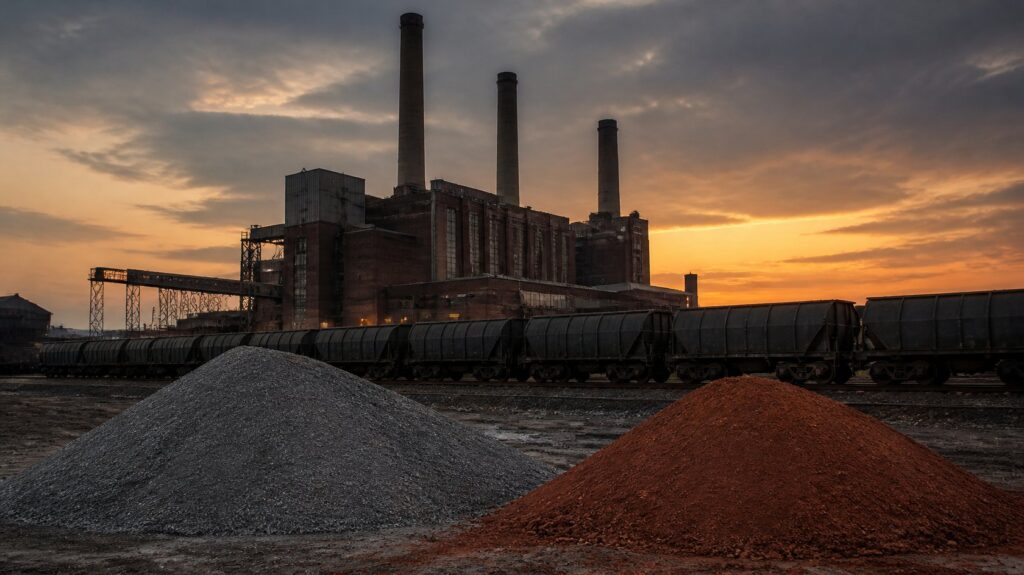
In October 2020 a brewery in Lieshout, in the southern Netherlands, made some of its beer with steam raised by burning iron. The boiler was a 100 kilowatt demonstration built by students and researchers from Eindhoven University of Technology with a consortium including Uniper and Nyrstar, connected to the brewing process at Swinkels Family Brewers, makers of Bavaria. TU Eindhoven described it as the world’s first industrial installation to use iron powder as a circular fuel. The by-product was rust.
Six years later, a group of German institutions is arguing that the same chemistry deserves a place in Europe’s energy plans. A report by the Institute of Energy Economics at the University of Cologne, commissioned by TU Darmstadt’s Metal Energy Hub and the DESERTEC Foundation, concludes that iron as an energy carrier could cut the annual cost of a decarbonised European energy system by about 15 billion euros in 2035 and about 18 billion euros in 2040 and 2045. The Karlsruhe Institute of Technology, a research partner, publicised the findings on 4 November.
How a metal stores energy
Finely ground iron burns in air at high temperature and produces heat but no carbon dioxide, leaving iron oxide. If the oxide is then reduced back to iron using hydrogen made with renewable electricity, the energy is stored again and the only by-product is water. The iron is not consumed; it cycles between charged and discharged states, like the active material in a battery. Unlike hydrogen, the charged powder is a stable solid that can sit in a heap or a silo for months and travel by ship or rail.
The commercial hook is the existing power station. Coal and lignite plants already have boilers, turbines, grid connections and solid fuel handling. In the EWI model, around 37 gigawatts of German hard coal and lignite capacity, and about 83 gigawatts across the modelled European region, is converted to burn iron by 2045, according to EWI’s summary. TU Darmstadt adds that the modelled iron store reaches about 58 terawatt hours in summer and is drawn down in winter, a quantity of the same order as Germany’s gas storage, and that converted plants could supply roughly a quarter of German district heating demand.
Winners and losers in the model
The full report, written by Philip Schnaars, Lisa Restel, Maximilian Walde and Christoph Mehler, finds that iron competes mainly with gas plants fitted with carbon capture and partly with hydrogen-fired turbines. Iron plants supply relatively little energy overall; their value is firm capacity in long, dark, windless spells. Savings amount to about 13 to 14 per cent of total system cost in the reference scenario.
If those results were borne out, owners of coal and lignite fleets would be the most obvious winners, since assets facing closure would gain a second life. Regions with mining employment, such as Lusatia and the Rhineland, would have a political reason to like the idea. Iron powder producers and makers of direct reduction equipment, a technology the steel industry is already developing for hydrogen-based steelmaking, could find a second market. The losers would be developers counting on carbon capture for gas plants and, at the margin, hydrogen turbine programmes, although KIT’s Professor Dimosthenis Trimis stresses that iron complements hydrogen rather than replacing it, since hydrogen is needed to recharge the powder.
Read the fine print
The figures are outcomes of modelled scenarios, not forecasts, as TU Darmstadt says explicitly. The study was commissioned by organisations that promote the technology. And the hardware is far behind the modelling: the Lieshout boiler was 100 kilowatts, while a coal unit is typically hundreds of megawatts. Large-scale iron combustion with stable flames and near-complete capture of fine oxide particles has not been demonstrated at power station scale, and regeneration of oxide back to iron in a cheap, efficient loop remains the costliest and least proven link. The round-trip efficiency from electricity to iron and back to electricity will be low, which is why the case rests on seasonal storage rather than daily cycling.
Still, the report changes the question. Iron fuel has spent years as a curiosity demonstrated in breweries and laboratories. A full energy-system model now says it could earn a place in the cost-optimal mix, which gives utilities and governments a reason to fund the much larger demonstrations needed to find out.