
Ulm-based NVision and Ulm University have shown a single designed molecule working as a light-connected spin qubit. The physics is peer reviewed; the roadmap to on-chip quantum computers is the company’s own.
NVision did not start out building quantum computers. The company, founded in 2015 and based in Ulm in southern Germany, made its name with quantum-enhanced MRI, a way of boosting the signal from sugar molecules so that a hospital scanner can follow how a tumour’s metabolism responds to treatment, with an initial focus on cancer imaging, as Ctech reported in May. Its anchor investor is Abbott, the diagnostics group. Yet on 28 October its scientists, with colleagues at Ulm University and the Hebrew University of Jerusalem, published a paper in Nature that is all about computing.
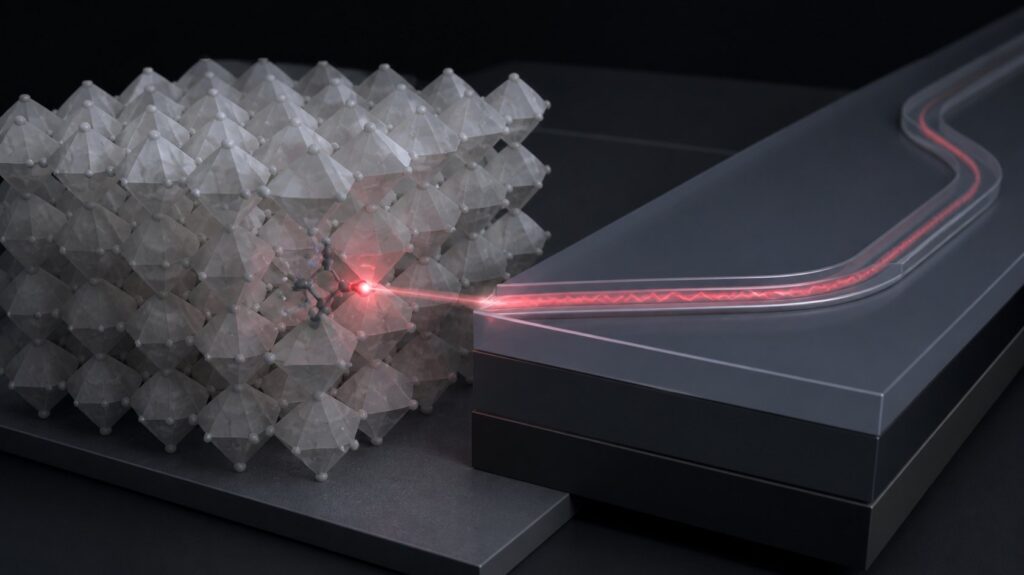
The paper, A single-molecule spin-photon interface, reports that one specially designed organic molecule can be initialised, controlled and read out individually as a spin qubit, using light to set and read its state and microwaves to manipulate it. Molecular spins have been studied for years, but only in groups whose signals had to be averaged. Individual addressability is what a computer needs.
A molecule designed for the job
The molecule is a carbene, a carbon compound with two unpaired electrons, embedded in a host crystal of a closely matched ketone. According to NVision’s announcement, the team screened more than 150 candidate molecules by computer and synthesised 40 before settling on it. In an independent summary of the paper, DesignQuantum lists the key measurements at 4.5 kelvin: photon statistics consistent with a single emitter, an optical linewidth of 38 MHz that drifted by only about 2.5 MHz over more than an hour, spin coherence of 2.2 milliseconds under dynamical decoupling and spin relaxation of 21 milliseconds. The authors say that is more than an order of magnitude better than earlier ensemble results for molecular qubits.
Outside scientists quoted by Chemistry World were impressed. David Awschalom of the University of Chicago called it a high-quality molecular qubit architecture; Danna Freedman of MIT described single-molecule addressability as a huge step for the field.
Why it could matter commercially
The leading quantum computing approaches, superconducting circuits, trapped ions and neutral atoms, all face a scaling wall: thousands of qubits must eventually be networked, probably with light. The paper places its molecule alongside colour centres in diamond as a spin-photon interface, with the claimed advantage that a molecule can be made in identical copies by chemistry and deposited as a thin film, much like the organic layers in an OLED display, onto photonic chips made in existing foundries.
That is the bet behind NVision’s partnership with HyperLight, a US maker of thin-film lithium niobate photonic chips used in data-centre optics. The companies say first prototype integrated chips are expected in the fourth quarter of 2026. NVision raised a $55m Series B in May, including a $17m European Investment Bank venture loan, bringing its total funding to $120m, according to the company. Investors include Playground Global, Entrée Capital, Matterwave Ventures and CDP Venture Capital. Chief executive Sella Brosh and chief technology officer Ilai Schwartz co-founded the business; Fedor Jelezko and Martin Plenio of Ulm University are among the paper’s authors.
If molecular qubits work on chips, the winners include photonic foundries and thin-film lithium niobate suppliers, whose products would gain a new market, and pharmaceutical customers, whom NVision hopes to serve with chemistry simulations. Companies that need bespoke fabrication plants for their qubits could find that a cheaper manufacturing story has appeared.
The distance still to travel
The gap between this paper and a computer is large and should be stated plainly. The demonstration involves one molecule at 4.5 kelvin. Emission efficiency into the useful optical line is about 2 per cent. Two-qubit gates and entanglement between molecules have not been shown. NVision’s targets of 1,000 physical qubits and then 1,000 logical qubits on chip by 2030, and its claim that the architecture tolerates up to 70 per cent photon loss, are company statements and not part of the peer-reviewed work. The paper’s competing-interests statement notes that most authors are NVision employees and several are shareholders.
What the paper does establish is that a qubit can be designed on a chemist’s screen and then made to behave as predicted, one molecule at a time. For a field that has largely accepted the materials nature provided, that is a new way of working.