
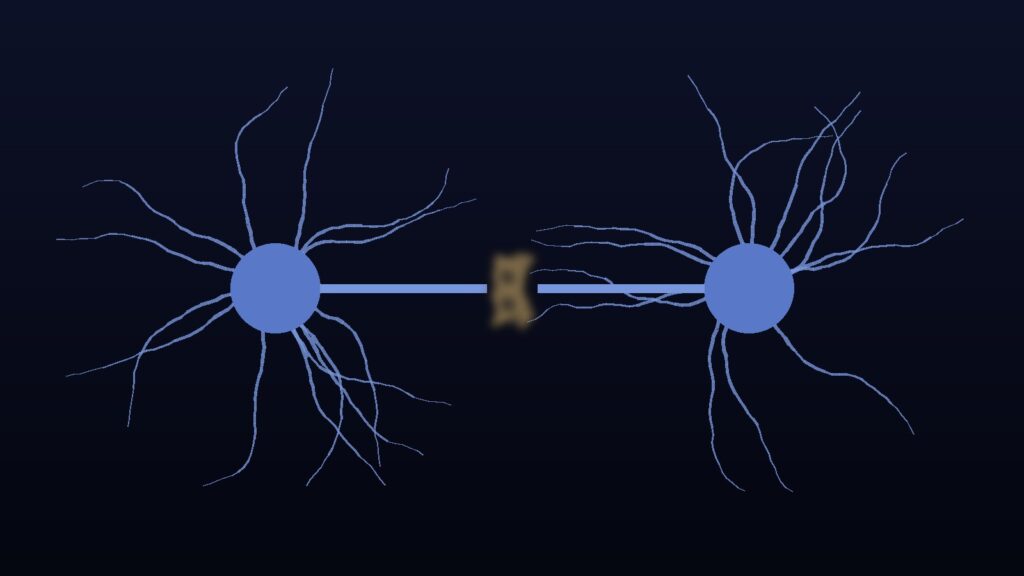
Researchers in London and Berlin found that when the protein TDP-43 fails, as it does in about 97 per cent of ALS cases, neurons stay intact but stop talking to each other, and one faulty gene message, UNC13A, explains most of it. An antisense drug that repairs that message restored signalling in human neurons in the lab. A related drug is now in human trials.
Near the bottom of the funding list on a paper published in Nature on 11 November sits a charity with an odd apostrophe in its name: My Name’5 Doddie. The 5 is a rugby shirt number. Doddie Weir, the Scotland lock who wore it, was diagnosed with motor neuron disease in 2016, set up the foundation the following year to pay for research, and died of the disease in 2022. Four years later, money raised in his name helped fund a study that pinpoints why nerve cells in most forms of the disease stop talking to each other, and shows that a drug can make them talk again.
The work, led by researchers at King’s College London, University College London, the Francis Crick Institute and the Leibniz-FMP institute in Berlin, with scientists from the US biotech Trace Neuroscience, is laboratory research in human stem cell derived neurons and a humanised mouse. It has not treated a patient. But it sharpens the case for a drug class that has already reached the clinic.
Why it matters
Motor neuron disease, also called amyotrophic lateral sclerosis or ALS, kills the nerves that drive muscles. King’s College London puts lifetime risk at about one in 300. Antisense drugs aimed at two inherited forms, caused by faults in the SOD1 and FUS genes, have shown early promise, but those forms account for under 3 per cent of patients. The other 97 per cent share one feature: a protein called TDP-43 leaves the cell nucleus, where it normally proofreads gene messages, and clumps in the surrounding cytoplasm. The same pathology appears in about half of frontotemporal dementia cases.
Without TDP-43, hundreds of gene messages are mis-spliced: stray fragments called cryptic exons get stitched in and the resulting protein is broken or missing. Researchers have known since 2022 that UNC13A, a protein that lets synapses release their chemical signals, is one of the casualties, and common variants of the UNC13A gene are among the strongest genetic risk factors for ALS. What nobody had shown was how much that single loss matters for the way neurons actually work.
How it works
The team edited human stem cells so that TDP-43 carried a molecular tag, grew them into mature cortical and spinal motor neurons, and then destroyed the tagged protein on command. That avoided disturbing early development and mimicked the disease in grown cells. The neurons that resulted looked healthy under the microscope. They had not degenerated. Yet their synapses had largely gone quiet. Rachel Jackson, a co-first author who did the work as a research associate at King’s, used live imaging to watch individual synapses fire and saw that the TDP-43 depleted cells communicated much less.
The striking result was that genetically repairing just one of the hundreds of mis-splicing events, the cryptic exon in UNC13A, was enough to rescue the defect. The researchers then designed splice-switching antisense oligonucleotides, short synthetic strands that bind the UNC13A message and steer the cell’s splicing machinery away from the faulty exon. In human neurons the drugs restored spontaneous and triggered release of signalling vesicles, the probability of release at single synapses and synchrony across the network. They also corrected the splicing in a mouse carrying the human version of the gene.
“We have now learned it’s the main driver of synaptic release deficits upon TDP-43 dysfunction,” said Pietro Fratta of UCL and the Crick, a senior author, in the King’s release.
From dish to clinic
A separate antisense drug acting on UNC13A by a similar mechanism is already being given to people. Trace Neuroscience, a South San Francisco company launched in 2024 by scientists who helped establish UNC13A as a target, began dosing in China in June 2026 through an investigator-led study run with Tenacia Biopharmaceutical at Beijing Tiantan Hospital. Its placebo-controlled Phase 1/2 trial, FUNCTION ALS, registered as NCT07674667, lists sites in Germany, the Netherlands and at UCL and the University of Sheffield, and plans about 30 participants with 24 weeks of follow-up. King’s says the first UK participants were dosed in October. The drug, TRCN-1023, is given by injection into the spinal fluid. The Nature paper’s own compounds are not TRCN-1023.
Funding came from the Medical Research Council, the MND Association, Wellcome, LifeArc, My Name’5 Doddie, Trace Neuroscience, the US National Institutes of Health, the UK Dementia Research Institute, the German Research Foundation, Target ALS and others.
Who stands to gain, and the caveats
If splice correction works in people, the beneficiaries would be the large majority of ALS patients who have no disease-modifying option, plus a share of dementia patients. The approach would also validate antisense chemistry for sporadic neurodegeneration, a field in which Ionis Pharmaceuticals and Biogen pioneered the SOD1 drug tofersen. Programmes aimed at other TDP-43 casualties, such as STMN2, would face a sharper question about which target matters most.
The caveats are substantial. Everything in the paper was measured in cultured neurons and a mouse model; restoring synaptic release in a dish is not the same as slowing paralysis. TDP-43 loss damages hundreds of transcripts, and neurons in patients may already be dying by the time of diagnosis, a stage this model deliberately avoided. Drugs injected into spinal fluid must reach enough motor neurons, repeatedly and safely. Trace Neuroscience co-funded the research and has a commercial interest in the target, and the trial is designed mainly to test safety, dosing and biomarkers rather than to prove benefit. The claim that the approach is relevant to 97 per cent of patients rests on the shared pathology, not on clinical evidence.
Listing check
Trace Neuroscience and Tenacia Biopharmaceutical are privately held and not available to buy on any exchange. Ionis Pharmaceuticals (Nasdaq: IONS) and Biogen (Nasdaq: BIIB), mentioned for context, are listed and have Trading 212 Invest instrument pages; neither is a party to this study.