
Chinese researchers kept anode-free sodium cells cycling for 1,400 cycles with a new electrolyte. Larger prototypes faltered, making coating and assembly quality the next commercial battleground.
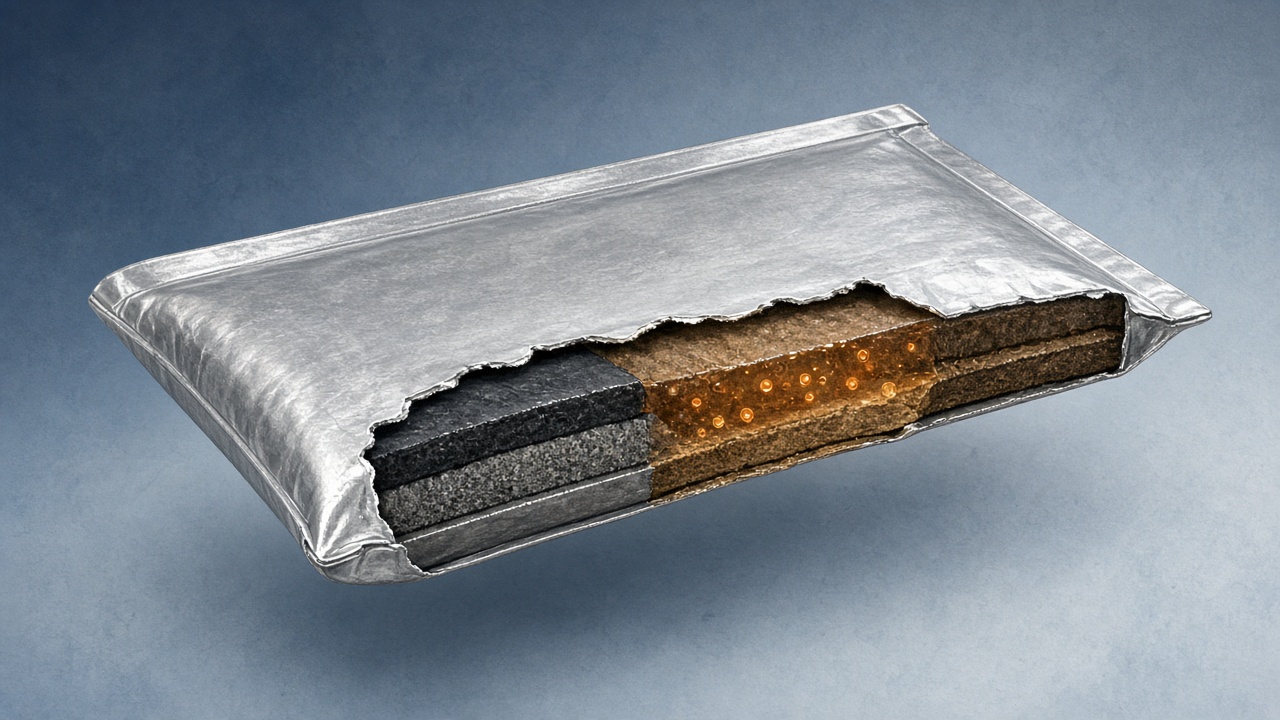
A pressure sensor and pressure-sensitive film supplied one of the most useful details in a new sodium-battery study. A pouch cell measuring 4.3 by 5.6 centimetres was held under 0.64 megapascals, equivalent to 156.6 kilogram-force in the researchers’ description. The team attributed its longer life partly to the resulting uniform, uniaxial pressure.
That mechanical detail belongs beside the electrochemical headline. Xi’an Jiaotong University, the Chinese Academy of Sciences and collaborators reported anode-free sodium pouch cells retaining about 80% of capacity after 1,400 cycles at 1C. Their chemistry addresses irreversible sodium loss, the central weakness of cells that begin without a pre-installed anode active material.
The work, published in Nature Energy on 2 November, was conceived by Weijiang Xue and Yong-Sheng Hu. Shuicen Ding designed the electrolyte and assembled the cells; Xijie Chen, Zhen Yao and Mengdi Hao were fellow first authors. Sodium supplied by the cathode plates directly onto a carbon-coated aluminium current collector during charging, saving the weight and volume of a separate anode.
One solvent, several qualifications
The electrolyte uses the cyclic ether 1,3-dioxane, or DOX. Weak coordination with sodium ions helps desolvation and reversible plating. Controlled oligomerisation at the interface forms a protective solid-electrolyte interphase that limits continuing electrolyte decomposition. The tested formulation combined sodium hexafluorophosphate with DOX and another ether solvent rather than relying on an unexplained miracle additive.
The headline result applies to approximately 300mAh pouch cells with cathode loading around 20mg per square centimetre. Supplementary Table 3 specifies a 0.3225Ah cell storing 0.979Wh and 149Wh/kg. The authors reported operation up to 3C and round-trip energy efficiency up to about 98%, a maximum test result rather than a guarantee for a complete storage system.
The cold figure also needs precision. At minus 40C, cells maintained 88% of their room-temperature capacity. They were not cycled 1,400 times at that temperature. The long cycling result was at 25C and 1C, and the main rate tests ranged from 0.1C to 3C.
The larger prototypes are more instructive than the headline. They also prevent a simplistic comparison with commercial cell specifications: the small cell’s 149Wh/kg is a laboratory figure calculated for the stated construction, while an installed battery would need packaging, monitoring and thermal controls. Removing anode material can save weight, but electrolyte, separator and current-collector requirements still determine the final total. A roughly 1Ah cell suffered localised sodium depletion or a short circuit at cycle 251. A roughly 4Ah cell retained 83.7% after 350 cycles while charging at 0.25C and discharging at 0.5C. Those are respectable research steps, but not the same endurance as the small cell.
The supplementary discussion points to tens-of-layer stacking, highly uniform coatings and precise electrode alignment. Small defects can produce local sodium depletion or a short circuit. This shifts the investment question from whether the solvent works in one laboratory format to whether manufacturers can reproduce clean interfaces and pressure over much larger areas.
The people, money and industrial contest
The declared funding came from the National Natural Science Foundation of China under grant 52472251, the Chinese Academy of Sciences’ Strategic Priority Research Program under XDA0400000 and Tsinghua University’s State Key Laboratory of New Ceramic Materials under KF202503. The authors declared no conflicts of interest. No company funding round or patent position associated with this paper was disclosed in the sources reviewed.
Commercial sodium batteries are already advancing without this architecture. CATL, BYD and HiNa are associated with sodium-ion products, but those must not be conflated with anode-free sodium-metal cells. More directly, Colorado spinout Mana Battery and TotalEnergies subsidiary Saft announced a joint development agreement in August 2026 for anode-free sodium technology, showing that industrial qualification is already a competitive activity.
Electrolyte suppliers and coating-equipment makers could benefit if the Chinese formulation proves manufacturable, while cell developers gain only if they can control plating at scale. Established lithium-iron-phosphate producers face no immediate threat: their cost, safety data, factories and bankability remain formidable. A successful anode-free sodium platform would first be exposed to niche cold-weather or weight-sensitive applications before any grid or vehicle contest.
Next milestones should include independently reproduced multi-ampere-hour cells, calendar-life and high-temperature storage tests, gas generation, abuse safety and a credible bill of materials. Production yield matters because a low-cost element does not guarantee a low-cost cell. The study offers a strong electrolyte mechanism and unusually frank scale-up evidence. Its own larger failures show why the manufacturing story has only begun.