
Cornell researchers repurposed the Arc gene to make immune-cell vesicles that suppressed melanoma in mice. The platform is inventive, but human safety, dosing and manufacturing remain wide open.
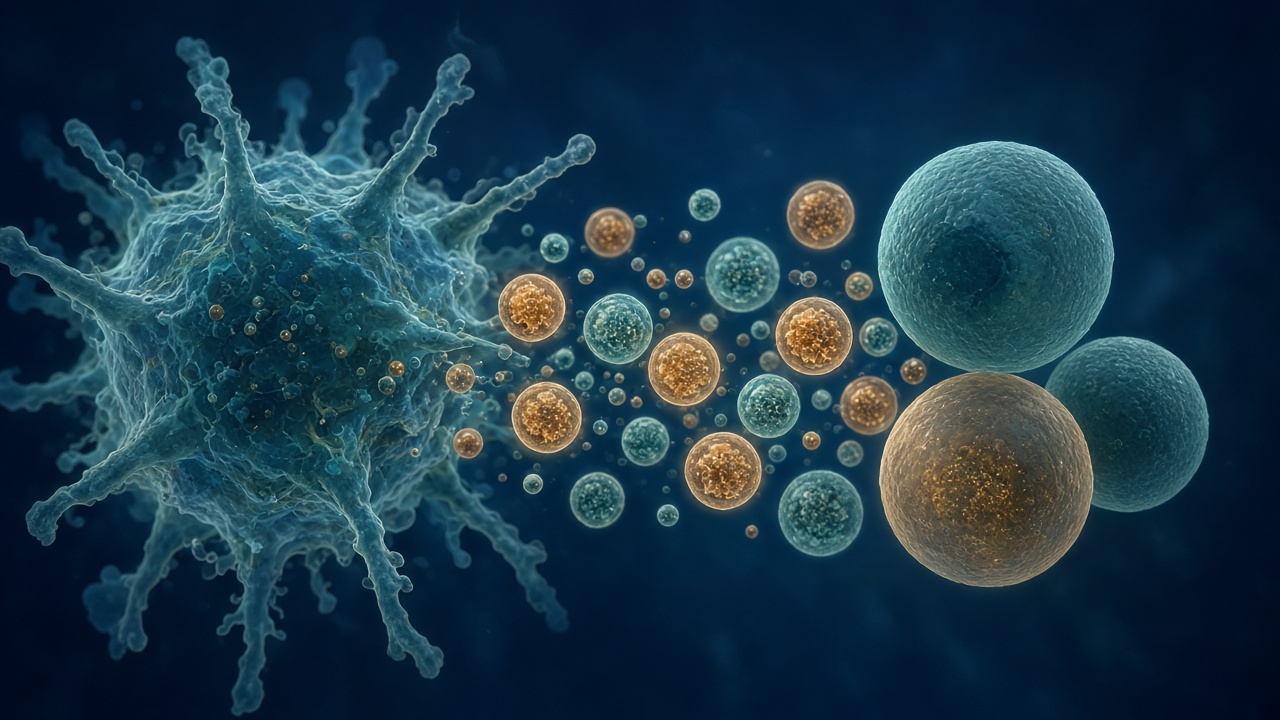
A gene associated with passing RNA between neurons has turned up in a different transport business. Dendritic cells, the immune system’s antigen-presenting sentinels, use the retrotransposon-derived Arc gene to assemble virus-like vesicles carrying peptide-MHC complexes and co-stimulatory molecules. Cornell University researchers have now shown how that natural packaging system might be redirected into a cancer vaccine.
Wenchao Gu and senior author Shaoyi Jiang led the work, with Ruoxin Li, Hayleigh Goodrich, Dorin Artzi and a large Cornell team. Their Nature Nanotechnology paper, published on 5 November, says Arc partners with endogenous envelope proteins after antigen exposure. The resulting vesicles can travel to lymphoid organs and engage T cells directly, using viral mimicry to provide an adjuvant effect without being a replicating virus.
In mouse experiments, vesicles lacking Arc failed to prime antigen-specific T-cell responses. Arc-enhanced vesicles instead produced rapid CD4-assisted priming and durable CD8-biased memory, suppressed B16-F10 melanoma and prolonged survival. This is a mechanism and a preclinical result, not evidence that patients with melanoma or any other cancer will benefit.
The mouse protocol sets the scale
The supplementary information makes the treatment regimen unusually concrete. Mice received four weekly intravenous doses through the retro-orbital sinus, each containing 60 billion vesicle particles in 50 microlitres. Preparations were made fresh. No treatment-related deaths or adverse effects were observed under that protocol, but this limited observation cannot establish clinical safety, especially for a platform deliberately designed to activate immunity.
Manufacturing is equally revealing. Roughly 70% to 80% of vesicles were Arc-positive when engineered from primary bone-marrow dendritic cells or macrophages, compared with up to 97% from the stable DC2.4 cell line. More Arc was not automatically better: the researchers found excess Arc in exosomal fractions lacking functionality. Those batch and potency questions will matter as much as the biological elegance.
The team also had to control for tumour-derived vesicle carry-over. They used concentrated B16-F10 culture supernatant as a broad antigen source, then capped inputs and processing so the final preparation predominantly reflected dendritic-cell vesicles. A patient-specific product would need equally rigorous identity and purity tests, alongside evidence that its antigen payload represents the tumour rather than cell-culture artefacts.
Cornell’s patents add a commercial dimension. The paper discloses applications PCT/US25/18869 and PCT/US2022/027568, filed by the university with Jiang and Gu as authors. Patent applications do not demonstrate freedom to operate, clinical value or a licence deal. No biotechnology spinout, licensee or commercial funding round tied to this vaccine was disclosed in the material reviewed.
The declared support came from Cornell start-up funding to Jiang, the Robert Langer ’70 Family and Friends Professorship, Cornell NEXT Nano and an inaugural Cornell Engineering Sprout Award. National Institutes of Health grants supported shared mass-spectrometry and imaging instruments. Those equipment grants should not be misrepresented as a clinical-development award.
Where the commercial pressure would fall
The platform’s attraction is its claim to be antigen-agnostic. The study also offers a possible explanation for why earlier dendritic-cell vesicle vaccines produced uneven immune responses. If Arc determines whether vesicles simply display antigen or also carry the co-stimulation needed for a durable response, then measuring vesicle number alone would be an inadequate release test. Developers would need assays for Arc content, surface ligands and biological potency. Rather than manufacture a fresh genetic sequence for every tumour antigen, a producer might use dendritic cells to package a changing antigen repertoire into immune-stimulating vesicles. If that works in people, suppliers of cell processing, vesicle purification, potency assays and contract development could gain. None has an announced role here.
Competitive exposure is less straightforward. Lipid nanoparticles and viral vectors already deliver cancer-vaccine cargo, while personalised mRNA programmes have large pharmaceutical backers. Arc vesicles could compete for the same partnerships, but they could also become another delivery option for those developers. Earlier dendritic-cell and exosome trials show that immune activation in a laboratory is only the beginning of a difficult clinical and reimbursement path.
A News and Views article by Yingying Hu and Raghu Kalluri places the result within that broader exosome field. It also discloses Kalluri’s patents and PranaX connection, underlining that vesicle biology already has commercial stakeholders rather than a clear field.
The decisive milestones are human-cell validation, a reproducible good-manufacturing process, biodistribution and dose-limiting safety work, then carefully designed early clinical trials. Researchers must also test whether immune memory translates beyond a fast-growing mouse tumour model. Arc has supplied a persuasive biological mechanism and protectable platform. It has not yet supplied a cancer medicine.