
HKUST researchers replaced intricate cooling tubes with stamped and stacked nickel-titanium sheets. The reported endurance and cost gains could help solid-state cooling, but an appliance’s efficiency and lifetime remain unproven.
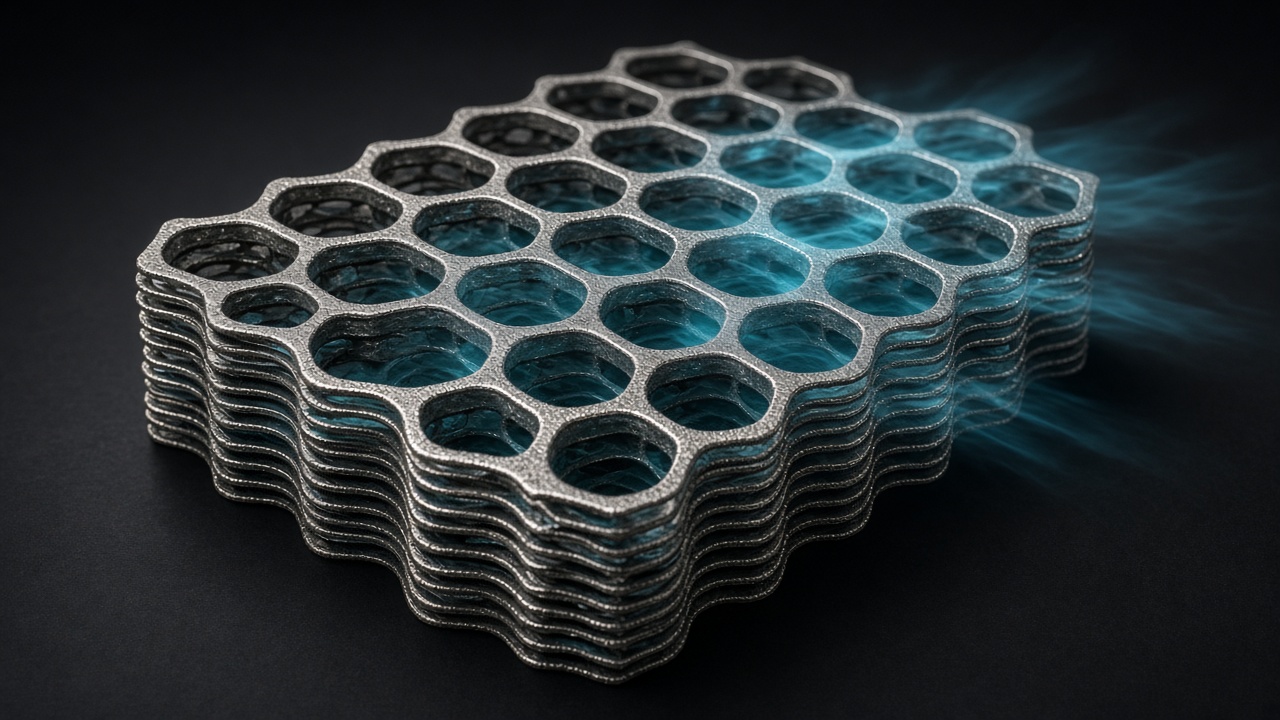
Thin-walled nickel-titanium tubes can move heat without a conventional gaseous refrigerant, but the way they fail is awkwardly mechanical. Repeated compression can buckle or split the tubes that engineers rely on for heat exchange. Changfeng Su and colleagues at the Hong Kong University of Science and Technology approached that weakness with a manufacturing operation more familiar to metal fabrication than exotic materials science: stamping.
The team stamped honeycomb-like chips from thin sheets of nitinol, a nickel-titanium shape-memory alloy, then stacked them into a porous tubular structure. The passages expose more surface to heat-transfer fluid while the geometry resists buckling. In Science on 5 November, the researchers reported more than 100 million compression cycles and specific cooling power of 3,850 watts per kilogram of material.
They also estimated that stamping and stacking reduced fabrication costs by an order of magnitude compared with existing approaches. That is the authors’ manufacturing comparison, not an independently audited production cost or a price for a finished heat pump. The 100 million cycles apply to the tested material structure, not the service life of an appliance containing pumps, valves, seals, actuators and controls.
Why geometry matters to investors
Elastocaloric cooling exploits the temperature change produced when a shape-memory alloy is stressed and released. Solid refrigerants could avoid high-global-warming-potential gases, but the system must repeatedly move heat into and out of a metal that is also undergoing enormous mechanical cycling. Better specific cooling power is useful only if total cooling capacity, temperature lift and coefficient of performance survive integration.
The paper identifies the main bottleneck clearly: making a fatigue-resistant structure with enough heat-transfer area at a cost compatible with production. Stamping could be more repeatable than machining intricate channels into individual tubes, while stacking allows a manufacturer to vary the number of layers. Yet dies, sheet quality, alignment and the flow resistance of the assembled passages all become production variables. A cheap chip is not necessarily a cheap heat exchanger. The Science page lists supplementary methods, 21 figures and four tables, but the publisher blocked retrieval of that supplement during this research. This article therefore confines the new performance claims to the accessible abstract, editor’s summary, author list and disclosures rather than inventing missing test conditions.
The authors are Su, Yang Li, Zhongzheng Deng, Shiyu Zhong of City University of Hong Kong, Jiyuan Hu, Xueshi Li, Qiao Li and Qingping Sun. Funding came from the Hong Kong Research Grants Council under STG2/E-605/23N and the Innovation and Technology Fund under GHP/127/22SZ. The paper declares no competing interests and does not identify a financing round or a company licensing this particular structure.
There is nevertheless a commercial path nearby. HKUST lists Sun as co-founder and chief consulting scientist of CoolStar Innovation Technology. Hong Kong Science Park’s directory says CoolStar had three full-time staff and one part-time technical adviser, with Runhua Zhou as chief executive. Its claimed 50% energy saving is a company statement about its own cold-chain product, not a measurement from this Science paper.
The distinction extends to earlier work. In March 2025, HKUST announced a 1,284-watt elastocaloric device using 104.4 grams of nickel-titanium tubes, with the figure measured at zero temperature lift. That machine demonstrated total capacity; the new stamped structure attacks fatigue and manufacturing. It should not be assumed that the new material has already been installed in CoolStar’s products.
A crowded route to the same radiator
CoolStar is not alone. Exergyn also uses nitinol, while Magnotherm and Pascal pursue different solid-cooling mechanisms. The three companies formed the Solid Cooling Coalition in October 2026 partly to standardise performance reporting, an acknowledgement that material-level records are difficult for customers to compare.
If stamping produces consistent parts at scale, HKUST-linked developers and metal-forming suppliers could benefit, and cooling manufacturers could license rather than invent the geometry. Exergyn would face a possible process improvement but could also adopt related manufacturing. Vapour-compression incumbents and refrigerant suppliers face displacement only if complete machines win on efficiency, maintenance, capacity and price.
The next evidence should therefore be a full refrigerator using the stamped structure, tested at a useful temperature lift over a realistic duty cycle. Independent costed production, corrosion and fluid compatibility, actuator efficiency and acoustic performance matter as much as another material endurance record. Solid cooling has a credible new manufacturing lead; it does not yet have a guaranteed appliance business.