
A Caltech payload funded by DARPA has autonomously assembled a section of truss in low Earth orbit. It finished one bay, not an antenna, but the method could change how large space structures are bought.
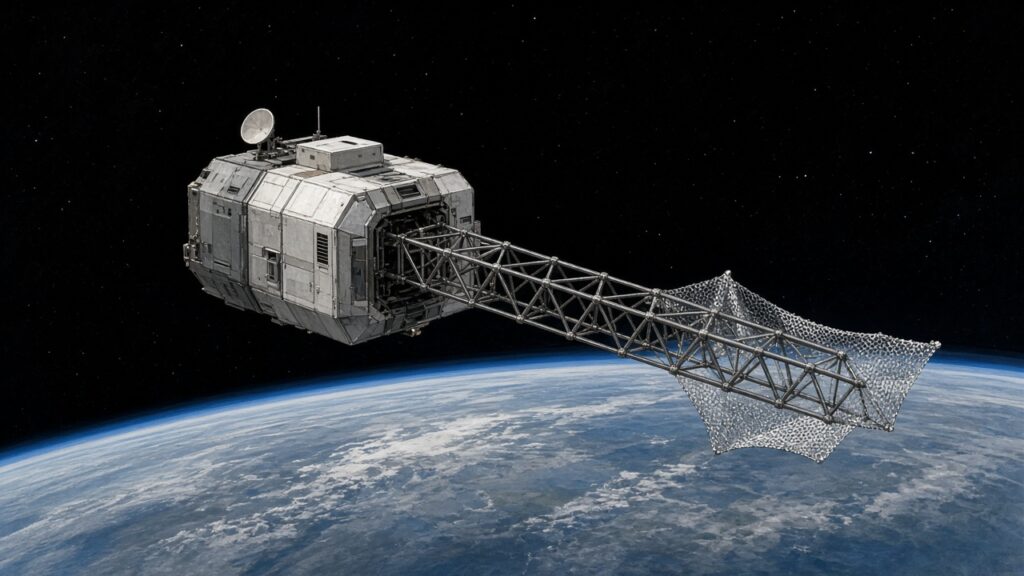
The robot that made history this autumn was not working alone. In a laboratory at Caltech in Pasadena sits its twin, a flight spare that engineers used whenever something went wrong in low Earth orbit. With only seven or eight communication windows a day, each lasting about 15 minutes, the team would reproduce a fault on the ground, test fixes, then send a workaround up to the original.
That routine produced what Caltech and DARPA describe as the first structure assembled autonomously in space. The payload, called ASTRA, short for Autonomous In-Space Tensioned Reflector Assembly, picked composite struts and aluminium joints from motorised dispensers and joined them into a bay of a perimeter truss, according to Caltech’s announcement on 5 November. DARPA’s own release calls it the first demonstration of automated in-space assembly.
The achievement needs careful sizing. ASTRA launched with two prebuilt bays, pushed them out, then built a third in orbit. The finished design needs 11 bays to hold a 1.4-metre reflector antenna. Caltech says time limits meant only the initial section was built, and with the mission ending in December, completing the truss now appears unlikely. No working antenna has been made in space.
Why build rather than unfold
Large space structures today are folded into a rocket fairing and unfurled, or assembled by astronauts from several launches. Both approaches cap size and add cost. DARPA’s NOM4D programme, short for Novel Orbital and Moon Manufacturing, Materials and Mass-efficient Design, began in 2022 to test a third route: launch a box of parts and build the structure where it will operate. Programme manager Andrew Detor says the eventual aim is structures hundreds of metres or even kilometres across.
Caltech’s approach is deliberately modest. DARPA describes the machine as a gantry robot moving along three linear axes, with no complicated robotics or advanced algorithms. Each bay is built on an assembly plate, a perforated reflective film is attached and the bay is pushed out before the next begins. The film was co-invented with Igor Bargatin’s group at the University of Pennsylvania and needs less prestress than conventional knitted metal mesh, which could allow lighter structures.
Sergio Pellegrino, the Caltech aerospace professor who leads ASTRA and co-directs its Space Solar Power Project, frames the result as proof that the concept works rather than a finished product. The team itself says the design must be simplified and refined, a reasonable reading of a demonstration that needed repeated workarounds.
Money, hosts and who could benefit
The funding is public and specific. ASTRA was built under a DARPA contract as phase three of NOM4D, after concept and laboratory phases. Caltech says the flight payload was completed and delivered in under 12 months. The value of the contract was not disclosed in the sources reviewed, and no patent filings tied to the demonstration were identified.
The commercial host was Momentus, the listed in-space transport company. ASTRA rode on its Vigoride 7 vehicle, one of 10 payloads launched on SpaceX’s Transporter-16 mission from Vandenberg on 30 March. Momentus said in June that ASTRA was its largest hosted payload and that it was operating under a DARPA contract. DARPA credits Momentus with integration, power, communications and imaging support. For a company still building a track record, a successful flagship customer is useful evidence, though one demonstration does not establish recurring revenue.
If assembly in orbit matures, plausible beneficiaries include makers of space antennas and reflectors, operators wanting larger apertures for communications, Earth observation or astronomy, and developers of space solar power. Suppliers of deployable structures face a longer-term scenario in which some very large designs move from folding to building, though deployables will remain the obvious choice for most satellites for years. These are reasoned possibilities, not announced contracts.
The obstacles are practical. A machine must build reliably without a twin on the ground diagnosing each hiccup, survey its own accuracy, and do so faster than a short mission allows. Military and commercial buyers will want evidence that a structure built in orbit holds its shape well enough for radio or optical work. The next marker inside NOM4D is a University of Illinois experiment on the International Space Station to cure composite materials in space. For ASTRA, the next meaningful milestone would be a mission that finishes a complete, measurable reflector.