
A 5MW system mixing alkaline and PEM electrolysers has won Chinese state recognition after field trials in Ningxia. The engineering targets fluctuating renewables, but the efficiency and cost data remain the developers’ own.
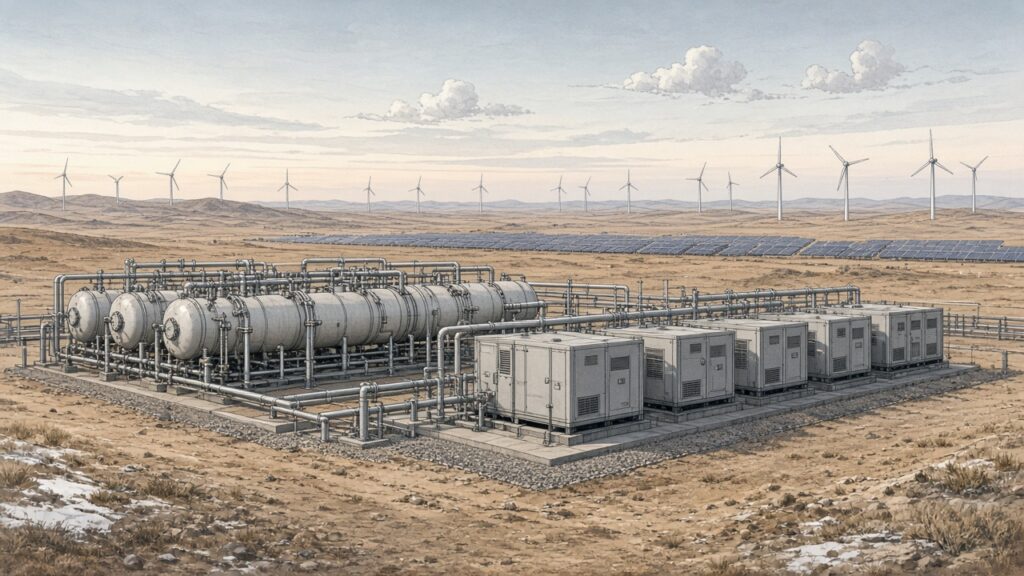
At Qingshuiying, in the Ningdong energy and chemicals base of Ningxia, a hydrogen plant spent a summer and a winter running an unusual piece of equipment. The 5MW system combines two established kinds of electrolyser, the alkaline units long used in industry and the faster-reacting proton exchange membrane, or PEM, stacks. On 23 October, China’s National Energy Administration listed it among 90 items in its sixth batch of first-of-kind major energy equipment.
Neither electrolysis technology is new. The claimed advance is in combining them, controlling them together and scaling the pairing to megawatts. According to the Xiamen University announcement on 6 November, the system ran stably between 16% and 160% of rated load, responded in as little as 10 seconds and reached a comprehensive energy consumption as low as 4.3 kWh per normal cubic metre of hydrogen.
What the numbers do and do not say
Those figures come from the developers and from a technology appraisal organised in March by the China Petroleum and Chemical Industry Federation, which rated the result internationally leading, according to China Energy Investment. No independent test report or peer-reviewed paper was found in the sources reviewed.
The 4.3 kWh figure needs particular care. At roughly 11.1 normal cubic metres per kilogram, it equates to about 48 kWh per kilogram of hydrogen. The public statements call it comprehensive consumption but do not define the measurement boundary, for example whether it includes rectifiers, gas purification, compression, cooling and balance of plant, or the operating point at which it was achieved. A best-case figure at favourable load is not the same as average consumption across a year of variable wind and solar power.
The load range is also an engineering result rather than an economic one. Running at 16% of capacity shows the system can follow weak renewable output; it does not show that hydrogen made at low utilisation is profitable. Operating above 100% for short periods may stress components, and the sources do not report degradation rates or stack replacement intervals.
The logic of a hybrid
Alkaline electrolysers are cheaper and mature but respond slowly and struggle at low load. PEM units cope better with rapid swings but use costly materials including iridium. A hybrid lets the PEM side absorb fast fluctuations while alkaline units handle steadier output, an approach that matters to large Chinese wind and solar bases where curtailment is a problem. Tan Kah Kee Innovation Laboratory previously had a high-current-density PEM electrolyser with a low-iridium anode recognised in a 2023 batch.
The project behind the system is the National Key R&D Programme hydrogen project on 10MW-class alkaline-PEM hybrid production, led by academician Zheng Nanfeng of Xiamen University. China Energy Investment’s Guohua Investment led the wider effort, with Guoneng Hydrogen Innovation Technology organising implementation. The listed developers also include Ludao Hydrogen Energy, Xi’an Jiaotong University and Huashang Xiageng Hydrogen Technology, with China Energy units as users. Project funding amounts were not disclosed in the sources reviewed.
Who gains and who is exposed
State recognition gives the developers access to policy support for first-of-kind equipment and a credential for tenders. China Energy Investment, as user and lead, gains operating experience at scale. In a scenario where hybrid systems become a standard design for large renewable hydrogen projects, control-system and integration expertise would become more valuable, which could favour groups able to supply both alkaline and PEM units.
Single-technology suppliers could face pressure to offer hybrids or better flexibility. Chinese alkaline makers compete heavily on price, while Western PEM suppliers such as ITM Power and Plug Power, and alkaline groups such as thyssenkrupp nucera and Nel, already compete on dynamic operation. That exposure is speculative until performance and cost data are published.
The rules of the scheme set the next milestone. The National Energy Administration requires developers and users to submit a self-evaluation after a year of operation. Investors should watch for degradation data, a clearly bounded energy figure and, above all, the cost per kilogram of hydrogen across real renewable conditions.