
Chinese and German chemists converted polyethylene into liquid hydrocarbons with a cheap iron catalyst and scaled the batch to a kilogram. The chemistry is promising; real mixed waste and industrial economics are untested.
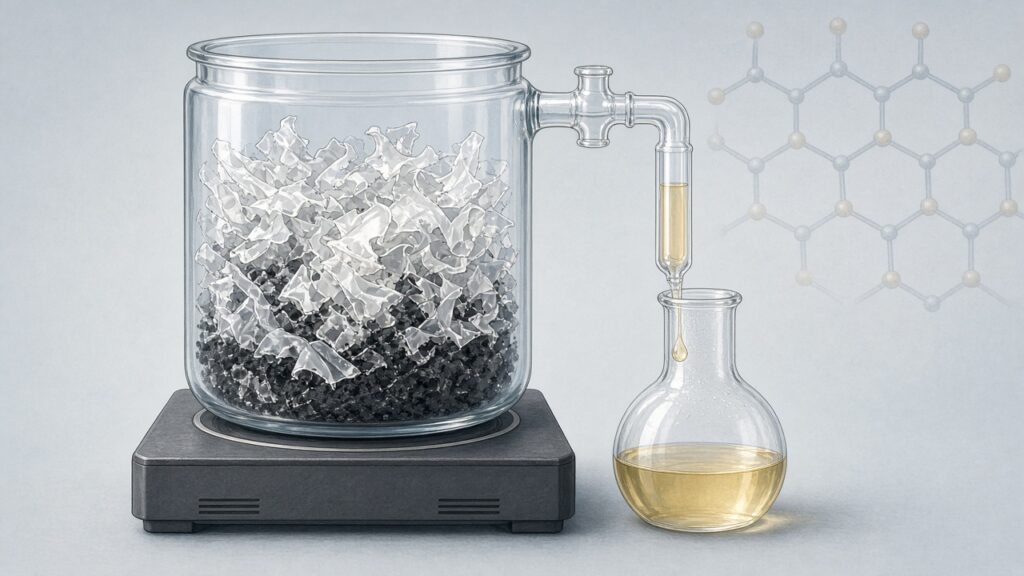
The test materials included commercial sealed bags and plastic cups, each cut into fragments about three millimetres square. In a custom quartz reactor in Nanjing, heated from below to 360°C and cooled with circulating water at the top, they turned largely into a light yellow oil and wax. The bags reached 93% conversion and the cups 96%.
Those results are part of a study published in Science Advances on 6 November by Guo-Ping Lu and Kangkang Sun of Nanjing University of Science and Technology and Nanjing Normal University, with Matthias Beller of the Leibniz Institute for Catalysis in Rostock. The catalyst is iron dispersed as single atoms on nitrogen-doped porous carbon, made from a zeolitic imidazolate framework, a class of metal-organic material.
What the numbers mean
Conversion and yield are different measures. Conversion is the share of plastic broken down; yield is the share ending up as the desired product, here liquid hydrocarbons with six to 35 carbon atoms. With a 50:50 mix of low- and high-density polyethylene, the team reported 97% conversion and a 94% yield of that liquid fraction after 50 minutes. Gases made up just 3%.
The process runs under argon with no external hydrogen, which distinguishes it from hydrogenolysis methods that need pressurised hydrogen and often precious metals. The cooled upper section matters: without cooling water, liquid yield fell from 94% to 58% and gas rose to 37%, because lighter molecules were cracked further. Below 320°C, conversion collapsed to 19%. Longer runs shifted output towards petrol-range molecules, and about 73% of the oil was olefinic, which the authors see as useful chemical feedstock.
Limits that matter
Polypropylene worked less well, with selectivity to liquids of about 51%. Pure high-density polyethylene converted more slowly than mixtures. The authors acknowledge that real waste contains additives, dyes, fillers, food residues and other plastics such as PET or PVC, which may hurt selectivity and catalyst life, and that sorting and cleaning would help. Clean commercial items are not the mixed, dirty stream a recycler receives.
The catalyst also tires. Activity held for three cycles, then conversion fell to 63% in the fourth as wax and coke blocked the active sites. Heating to 900°C under nitrogen for two hours restored performance to 95% conversion, and the iron remained atomically dispersed. Recovery used washing with dichloromethane, a chlorinated solvent. The catalyst itself is made by pyrolysis at 900°C, so the energy and solvent footprint of manufacture and regeneration would need full accounting.
Scale is real but small. Batches went from 4 grams to 10 grams, 100 grams and one kilogram, with 89 grams of oil from the 100-gram run. The authors estimate an upper bound of 5.6 kWh of electricity per kilogram of plastic for the kilogram batch, based on heater rating and time. That is a laboratory estimate, not an industrial energy balance.
People, money and the market
Funding came from the Basic Research Programme of Jiangsu, the Jiangsu Provincial Department of Education, the National Natural Science Foundation of China and China’s central university research funds. The authors declare no competing interests. No patent filing or company partner was disclosed in the paper.
Chemical recycling of polyolefins is crowded. Firms such as Plastic Energy, Mura Technology and Agilyx, and refiners and chemical groups including ExxonMobil, BASF and LyondellBasell, pursue pyrolysis or related routes. A cheap, iron-based catalyst that keeps output in the liquid range could interest operators fighting low selectivity and high temperatures. In that scenario, catalyst makers and plant licensors would be natural partners, and suppliers of more expensive catalysts could face pressure. Nothing in the paper shows that outcome yet.
Before any environmental claim can be made, the process needs a life-cycle assessment against incineration and mechanical recycling, continuous operation rather than batches, tests on genuine mixed waste and evidence of catalyst lifetime. The olefin-rich oil also needs upgrading before it becomes plastic again. The next milestone is a pilot with real waste, measured over hundreds of hours.