
An Australian spin-out has won A$15m of public money to scale a ceramic tube electrolyser that runs on industrial steam. The efficiency gain is real and measured, but the demonstration is still only a few hundred kilowatts.
Engineering consultancies do not usually buy shares in the projects they are hired to design. Amarna Energy has done exactly that. Its director, Andrew Lelliott, is quoted in CSIRO’s announcement of 6 November saying the firm does not often put its own money into the work it takes on, but that the results from a steelworks in New South Wales made the decision easy. The firm is designing the balance of plant for the project and has invested in the company at the same time.
The company is Hadean Energy, a Melbourne business co-founded in 2023 by CSIRO, Australia’s national science agency, and the corporate advisory group RFC Ambrian. On 6 November the Australian Renewable Energy Agency confirmed funding of A$15.13m towards a project costed at A$30.25m, according to ARENA’s own project record. The money will build an industrial demonstration of 200 to 300 kilowatts.
Heat instead of electricity
The idea is old in principle and awkward in practice. A solid oxide electrolyser splits steam rather than liquid water, at high temperature, so part of the energy needed to break the molecule arrives as heat rather than as electricity. Since electricity is the dominant cost in making hydrogen, swapping some of it for steam that a factory is already producing and usually throwing away changes the arithmetic.
The measured result is the strongest part of the story. CSIRO ran a 1,000-hour pilot with BlueScope at the Port Kembla Steelworks, beginning in October 2024, using steam from the steelmaking process. It produced hydrogen using less than 36 kWh of electricity per kilogram, against the 50 to 55 kWh that CSIRO says other electrolyser technologies typically need. That is a measurement from a real industrial site over a meaningful run, not a laboratory extrapolation, although it has not been published in a peer-reviewed journal and the figure covers electrical input rather than total energy, since the steam is treated as free.
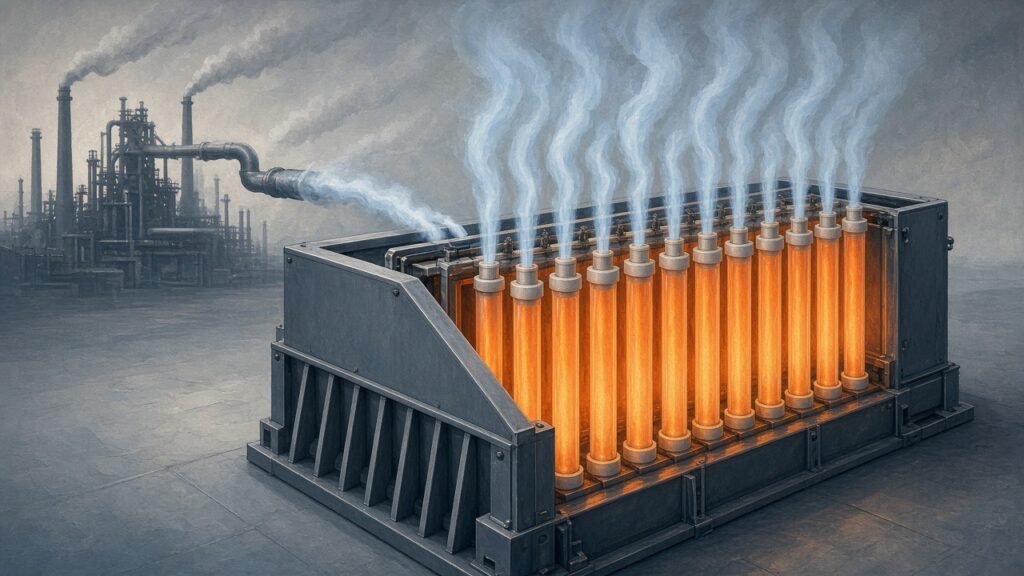
The hardware itself is a departure from the usual high-temperature design. Most solid oxide electrolysers are built from flat ceramic plates, which are difficult to seal and prone to cracking as they heat and cool. Hadean uses tubes. CSIRO says the tubular geometry simplifies manufacturing, improves durability and removes points of failure, and avoids rare and expensive metals. Dr Gurpreet Kaur, a senior research scientist at CSIRO, frames materials and cell design under industrial conditions as the thing that separates promising research from an industry-viable machine.
How this differs from the Chinese approach
This is a different answer to the same problem from the one described in our report on a 5MW hybrid alkaline and PEM system recognised in China last month. That design pairs two low-temperature technologies so the plant can chase a wind and solar supply that swings from 16% to 160% of rated load. Hadean is doing the opposite. It is tying the electrolyser to a steady industrial host that supplies heat, and buying efficiency rather than flexibility. Both routes are credible, and they point at different customers: one at remote renewable sites, the other at existing chemical, refining and metals plants with waste heat to spare.
Who gains, and what is still unproven
The declared beneficiaries are industries that already consume hydrogen made from gas or coal. ARENA says the pilot plant should produce up to 7 kg of hydrogen an hour and supply about 85% of the hydrogen needed for an annealing process in steel manufacturing. That is a deliberately unglamorous target, and a sensible one, because it sells into demand that exists today rather than a future hydrogen economy. The plant will be built in Victoria, subject to final deployment arrangements and approvals, and the hydrogen used at a neighbouring industrial facility. The earlier trial was at Port Kembla; the new demonstration is a separate site.
Hadean’s chief executive, Liz Boylan, puts the goal as proving the economics at commercial scale for the hardest industries to decarbonise. Investors in the current round include RFC Ambrian Funds Management, Amarna Energy and private backers, and RFC Ambrian’s executive chairman Rob Adamson acknowledges a reset in global hydrogen investment, which is an unusually frank thing for a backer to say in a funding announcement.
The caveats are mostly about scale and time. ARENA records the project running from January 2026 to August 2030, and the aim is to move from roughly 1 kW to 200 to 300 kW, and from technology readiness level 6 to 9. A commercial electrolyser installation is measured in megawatts, so even a fully successful demonstration leaves another large jump ahead. The 30% electricity saving is conditional on process heat being available at the right temperature and reliability, which excludes many sites. Solid oxide cells have historically degraded faster than alkaline ones, and no long-run degradation data has been published here. Hadean also expects to raise further capital over the next twelve months for construction, so the project is not fully funded. Finally, these figures are in Australian dollars, and the syngas route that CSIRO’s Dr Sarb Giddey describes, converting steam and carbon dioxide in one step, remains an opportunity rather than a demonstrated product line.