A Chinese and German team used machine learning to design ductile irons made entirely from contaminated scrap. In laboratory tests the best recipes were stronger or more ductile than earlier recycled iron and about 8 per cent cheaper to make, but they have not yet been run in a commercial foundry.
Liuliu Han leads a Max Planck partner group that sits not in Germany but at the Suzhou Laboratory in eastern China, according to heise. The paper he co-led with colleagues in Shanghai, Hong Kong, Changsha and Düsseldorf lists among its funders a scheme with an unusually regional name, the “Science and Technology Revitalizing Inner Mongolia” Special Project of Shanghai Jiao Tong University, as the university notes. Its abstract is bolder still. It claims to reverse “a five-millennia-old metallurgical injunction”: that you purify the metal before you trust it.
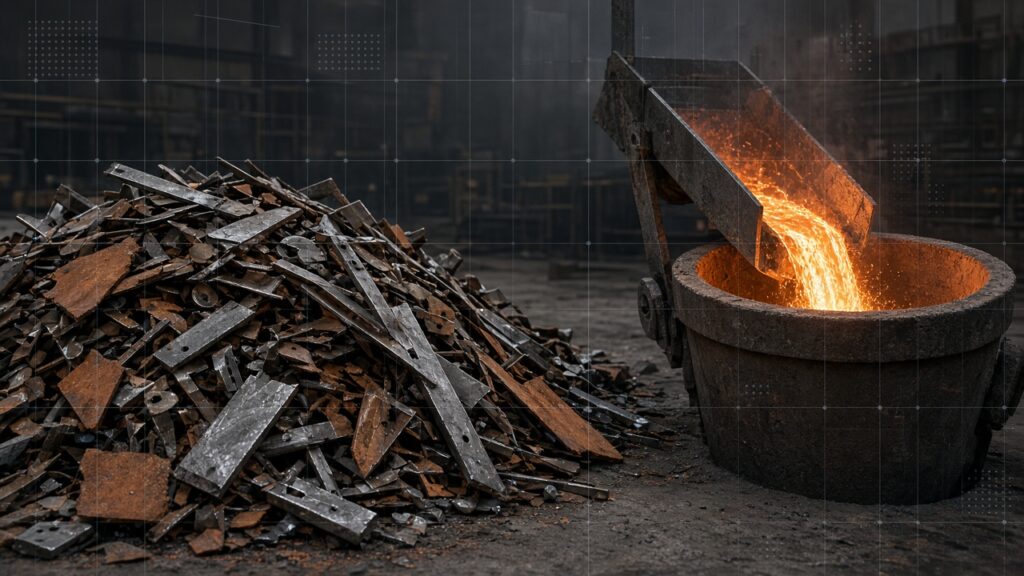
The work, published in Science Advances and announced by the Max Planck Institute for Sustainable Materials on 15 October, takes aim at one of the quieter obstacles to a circular economy for metals. Scrap is cheap and far less carbon-intensive than ore, but it is chemically unpredictable. Stray elements, from copper wiring to coatings, end up in the melt and can make the finished alloy brittle. Foundries usually cope by diluting the scrap with virgin metal, which caps how much recycled material they can use and erodes the environmental benefit.
Designing around the contaminants
The team, led by first author Chao Yang of Shanghai Jiao Tong University with co-first author Bo Peng of City University of Hong Kong, took the opposite approach. Instead of treating impurities as a defect to be removed, they asked which combinations of composition and processing would turn them into useful alloying ingredients. Their framework, which they call DAS-DAO, starts from known alloy recipes, uses a tree-search algorithm to propose variations in composition, heat-treatment temperature and time, and asks two neural networks to predict each candidate’s tensile strength and elongation. A second model trained on a larger dataset screens the shortlist before anything is melted.
The researchers chose ductile iron, also called nodular cast iron, as their test case. It is tolerant of impurities, which makes it hard to model with conventional thermodynamic tools, and it matters industrially: the paper puts its use at about 28 per cent of global cast iron consumption, or roughly 120 million tonnes a year. The group cast and tested 17 designs suggested by the model. According to the institute, 14 of them beat the best strength and ductility combinations in the existing recycled-iron dataset, with tensile strength up to 15.2 per cent higher at comparable elongation, or elongation up to 73.2 per cent higher at comparable strength. Manufacturing cost was put at 8.1 per cent lower than the conventional route of blending scrap with virgin iron.
Why it matters
Metal production is one of the largest industrial sources of emissions. The Max Planck institute cites estimates that it accounts for about 10 per cent of global energy use and around 8 per cent of total greenhouse gas emissions. Making more of it from scrap is the obvious lever, and Europe and China both want to reduce their dependence on imported ores and strategic alloying elements. If a foundry can accept a wider range of scrap without losing quality, the economics of collection and sorting change, and scrap grades that now sell at a discount could become more valuable.
The plausible winners are foundries and recyclers that already handle large volumes of mixed iron and steel scrap, along with makers of castings for pipes, automotive suspension parts and machinery, where ductile iron dominates. Suppliers of virgin pig iron used for dilution could see weaker demand if the approach spreads. Software and data matter here too: the model is only as good as the composition and property records it learns from, so foundries with long, well-kept melt histories would hold an advantage.
The caveats
The results are laboratory castings, measured against a dataset of earlier recycled irons rather than against every commercial grade, and the cost saving is the authors’ estimate rather than a figure from a production line. The gains are reported as trade-offs: strength at comparable ductility, or ductility at comparable strength, not both at their maximum. Scrap composition also varies from yard to yard and from day to day, so the real test is whether the recipes stay robust across charges in an operating foundry, and whether properties such as fatigue and impact resistance, which matter for safety-critical castings, hold up.
The team says it plans to apply the method to recycled steels and to aluminium and copper alloys, according to heise. Those could prove harder, because many steels are less forgiving of residual elements than cast iron. The work was supported by China’s 2030 National Major Science and Technology Project and the Shanghai Natural Science Foundation, alongside the Inner Mongolia programme. Dierk Raabe of the Max Planck institute is a corresponding author with Han and Ye Wei of City University of Hong Kong.
Listing note: the work comes from universities and public research institutes, and no company is named as a partner, licensee or funder in the paper’s public materials, so there is no listed company exposure to report.