
A cheap polymer membrane usually used only as a backing layer can sort crude oil molecules once heavy hydrocarbons partly block its pores, KAIST and Georgia Tech researchers report in Nature. Modelling suggests a third less distillation energy, but the four-week trial was laboratory scale.
Dong-Yeun Koh learned his trade as a postdoctoral researcher in Ryan Lively’s laboratory at Georgia Tech in Atlanta. In 2020 that laboratory, with ExxonMobil and Imperial College London, showed in Science that a specially designed polymer membrane could split crude oil by molecular size. The idea was elegant; the flow rates were poor. Koh now runs his own laboratory at KAIST in Daejeon, and his former supervisor appears as a co-author on the follow-up, which has an unlikely premise: the answer was a cheaper, cruder membrane that only starts working once it begins to clog, as Georgia Tech recounted.
The paper appeared in Nature on 24 June, so this is not new research. It is worth revisiting because it has since drawn a commentary in Nature Chemical Engineering and fresh coverage this month, and because the stakes are large. According to the paper, atmospheric and vacuum distillation of crude oil consumes more than 1,100 terawatt-hours a year and emits more than 160 million tonnes of carbon dioxide equivalent. Distillation works by heating crude to well above 350C and condensing the vapours. Any technology that can do part of that sorting without heat goes straight at one of the most energy-hungry steps in heavy industry.
Fouling turned into a feature
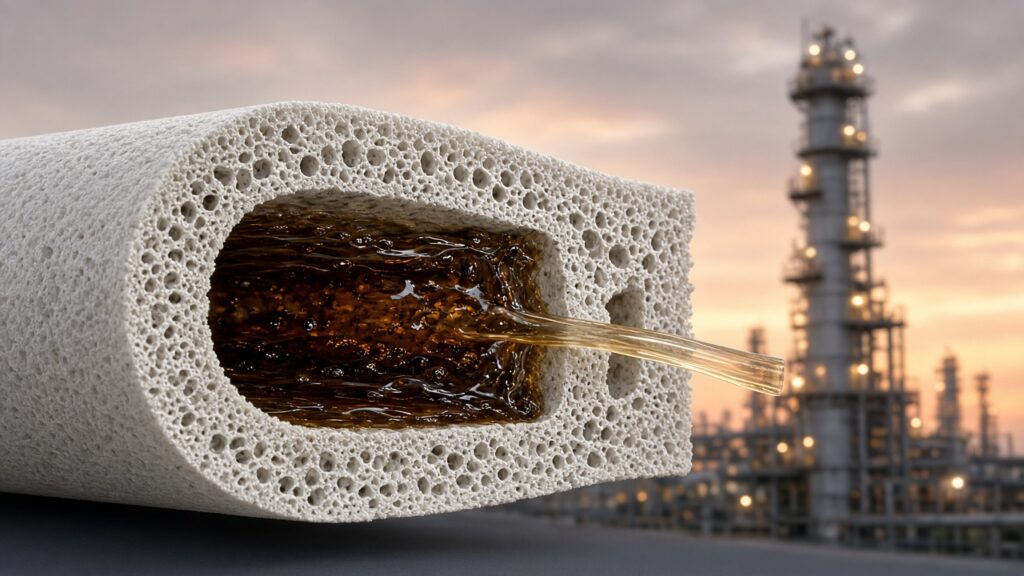
The team tested polyacrylonitrile, or PAN, a cheap and chemically stable polymer that the filtration industry normally uses as a porous support beneath a thin selective coating. Its surface pores start at about 15 nanometres, far too large to separate hydrocarbons on their own. But when real crude flowed across it, long straight-chain alkanes from the heavier fraction built up on the pore walls and narrowed the channels to below 2 nanometres. The deposit then appears to limit itself, so lighter molecules such as naphtha and kerosene pass while heavier ones are held back. In most filters this kind of build-up, known as fouling, is a fault. Here it formed the selective layer.
The measured numbers are striking for a membrane with no engineered coating. The researchers report crude oil permeance of up to 0.591 litres per square metre per hour per bar, more than 23 times the previous benchmark, with stable enrichment of lighter fractions over four weeks of continuous operation. The crude came from HD Hyundai Oilbank, the Korean refiner, whose researcher Woong-Chul Shin is a co-author. The Korea Research Institute of Chemical Technology also contributed.
What the modelling claims
The energy figures are projections, not measurements. Process simulations in the paper suggest that using PAN membranes to pre-fractionate crude before the distillation column could cut energy use by 31.6 per cent, cooling water by 20.7 per cent and carbon dioxide emissions by 37.6 per cent compared with conventional atmospheric distillation. Georgia Tech’s summary rounds these to about 30, 20 and 35 per cent. Lively told the university the productivity gain was large enough that “industry should seriously consider adopting the technology”, which is an advocate’s view rather than an independent verdict.
The Nature Chemical Engineering commentary is more measured: it says the next step is to evaluate the membranes in integrated refinery operations, including their effects on overall energy efficiency, how units fit together and the quality of downstream product streams. Crudes vary widely in their wax and asphaltene content, and a membrane whose selectivity depends on what deposits in its pores may behave differently on a heavier or waxier feed. Scaling from laboratory modules to the enormous flows of a refinery, and keeping performance stable for years rather than weeks, remain open questions.
Who gains
If it works at scale, the first beneficiaries would be refiners facing carbon prices or emissions caps, especially in Europe and East Asia, because a membrane step could be bolted in front of existing columns rather than replacing them. Membrane manufacturers would gain a large new market for a commodity polymer. Makers of furnaces and heat-exchange equipment for crude units could see slower growth. The irony is that a technology born to cut refining emissions would also make oil processing cheaper, which matters for the climate case: lower costs per barrel do not by themselves reduce oil demand.
Listing note, checked 11 November 2026: HD Hyundai Oilbank is not itself listed; it withdrew a planned share sale in 2022, according to KED Global. Its majority owner, HD Hyundai Co., trades on the Korea Exchange under 267250, and Saudi Aramco, which held a minority stake in Oilbank according to 2022 reporting, trades on the Saudi Exchange under 2222. Both are only indirect exposure and neither owns this invention. We did not find either in Trading 212’s instrument catalogue. ExxonMobil (NYSE: XOM), a partner on the 2020 study but not this one, has a Trading 212 Invest instrument page. This is not investment advice.