
Nvidia posted the biggest quarter in its history and its shares fell. Anthropic completed the largest share sale on record and gave back most of its first-day gain within a day. Washington started licensing access to computing power itself. Our view: the week marked the point at which technology stopped being priced on promise and started being asked for proof, and that is healthier than it feels.
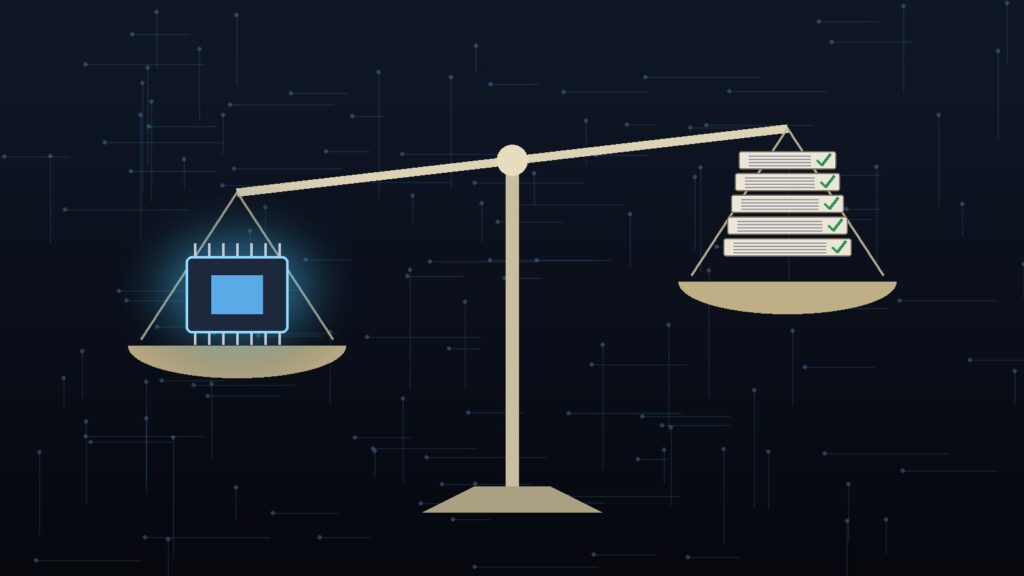
For most of the past three years, the technology industry has enjoyed something more valuable than capital: the benefit of the doubt. Investors, regulators and customers were willing to assume that spending would turn into revenue, that new systems would prove reliable once scaled, and that the hard questions could wait. The week from Monday 16 to Saturday 21 November 2026 was the week that patience visibly thinned. It did not snap. Demand for computing remains enormous and the laboratories kept producing striking work. But almost every major story of the week turned on the same request: show us. This editorial sets out what happened and then says plainly what we think it means. Where we offer opinion or forecast, we say so.
A record quarter that did not buy any patience
Start with the numbers, because they are extraordinary. Nvidia reported third-quarter revenue of $115.8 billion, up 103% on a year earlier, with data centre revenue of $107.6 billion, up 110%. It guided to about $130 billion for the current quarter, ahead of expectations, according to InformationWeek. Colette Kress, interim chief executive since Jensen Huang resigned the week before, said in the results release: “Our momentum is real.”
The market did not argue with the momentum. It argued with everything around it. The shares fell nearly 3% the day after the report, InformationWeek noted, leaving them about 36% below their 6 October record close and heading for a seventh straight weekly loss. On Friday, CNBC reported, Nvidia and AMD each dropped more than 13%. On the results call, chairman Harvey Jones said the board “does not intend to reinstate Jensen as CEO”, hours after Huang had issued a written statement saying he would be “honored” to return if the board judged it in the company’s interest. That is an unusual public split for a company of this size, and investors noticed.
Our view: the fall says less about Nvidia’s business than about what the market now demands. A doubling of revenue used to be enough. Now investors want to know who is running the company, how exposed it is to Washington, and whether its customers can keep paying. We argued in last week’s editorial that the AI boom was discovering what it stands on. This week it discovered that those foundations are being inspected.
Anthropic: the first frontier lab meets a ledger
The symbolic event of the week was Anthropic’s arrival on Nasdaq on 19 November. It priced at $83 a share, opened at $111.50 and closed at $97.17, according to CNBC, after raising $81.3 billion in what CNBC described as the largest IPO of all time. InformationWeek put gross proceeds at roughly $93.5 billion once underwriters bought extra shares, alongside a $26 billion private placement from companies including Microsoft, Nvidia, Google, AMD, Broadcom, Micron and TSMC. On Friday the shares fell 8.5%.
For the first time, the economics of a frontier AI developer are on a public ledger, and the ledger is sobering. Business Insider reported third-quarter revenue of $17 billion and a net loss of $23.3 billion. InformationWeek cited nearly $900 billion of computing commitments. Jay Goldberg of Seaport Research, who started coverage at neutral, wrote that Anthropic is “an incredible company, but it is also asking for an incredible leap of faith by investors”. He was specific about why: “We are concerned about Anthropic’s revenue growth. It slowed sharply in Q3 and may not improve much in Q4.” Benzinga’s account of his note puts quarter-on-quarter growth at 144% in the second quarter and 43% in the third, and records his view that a shortage of computing capacity is the most likely explanation for much of the slowdown, something Anthropic has not confirmed.
Not everyone is cautious. William Blair analysts, rating the shares outperform, said they see the potential for “a significantly profitable business over time”, while conceding that “there is a lot that is uncertain about the future.” Chris Beauchamp, chief market analyst at IG, pointed at the plumbing of the deal instead: “Insiders can sell 10% of their holdings from day one, a major wave of shares hitting the market, and from a company which is still losing money.”
Our view: Goldberg’s framing is the right one, and it applies well beyond one company. A frontier model business is a bet that revenue can outrun a compute bill measured in hundreds of billions. That bet may pay. But it is now being made in public, quarter by quarter, and a slowdown from triple-digit to double-digit sequential growth will be read as information rather than noise. David Hsu of the Wharton School made a related point to NPR: it remains unclear how far AI’s gains will reach the rest of corporate America, beyond technical tasks such as writing code. That is the question that matters, and no IPO can answer it.
The underrated story: computing power became a licensed resource
If we had to pick the single development most likely to matter in five years, it would not be a share price. It would be the interim rule the US Commerce Department issued on 16 November. As CSIS researchers Kate Koren and Kevin Kurland explain, it requires a licence when exported hardware will be used by a data centre anywhere in the world to supply more than a set amount of compute to companies headquartered in China or other arms-embargoed countries. The threshold is low: they estimate it at roughly 750 H200 chips. Existing arrangements have 90 days to stop or obtain a licence, and Indonesia, Malaysia, Singapore, Thailand and Brazil join the list of countries needing licences for advanced chips.
Analysts canvassed by Reuters grasped the scale of the shift. “Export controls 2.0 is here,” said Neil Shah, vice president of research at Counterpoint Research. “Losing remote access creates a severe short-term compute bottleneck for Chinese tech giants, but it is a massive long-term catalyst for decoupling.” Charu Chanana, chief investment strategist at Saxo, called it “a meaningful escalation because restrictions are moving beyond who can buy advanced chips to who can access their computing power remotely”, adding that “the assumption that every part of the value chain benefits equally is becoming harder to defend.” Gary Tan of Allspring Global Investments expects “a two-tier market that favours trusted providers and US hyperscalers”.
Our view: this is the story markets are underpricing. Until now, a cloud service was not an export. From this week, the question of who is allowed to use a data centre is a matter of licensing, monitoring and enforcement, and the CSIS authors warn that vague due-diligence requirements may push companies into over-compliance. Compute is starting to look less like a commodity and more like a regulated utility with a passport check at the door. That will raise costs, slow some buildouts in Southeast Asia, and accelerate China’s push for domestic chips. It is also a reminder that the AI supply chain is now a foreign policy instrument, and it will be governed like one.
Reliability is the hard part, and this week proved it three times
Three stories from very different industries told the same lesson. Microsoft published its account of the near 24-hour outage that took down Outlook, Exchange and other services on 12 and 13 November. The Guardian reported that it blamed a months-old bug, malfunctioning internal connections and server capacity. Charles Lamanna, the Microsoft executive who set out the findings, described how a defect introduced in July surfaced only when traffic shifted and about 14% of gateway capacity was already out of service: “In less than two hours, the previously unknown defect was encountered across our fleet and rendered them unresponsive.”
In Florida, United Launch Alliance said its preliminary review of the 15 November Vulcan failure, which destroyed 40 Amazon Leo satellites, pointed to “inadequate fuel supply from the vehicle to the BE-4 engines, not from the performance of the engines”. ULA chief executive Mark Peller told an audience that “we had a significant shortfall in booster first stage performance.” Vulcan is grounded again, and Amazon, which has bought 38 Vulcan launches, waits.
And in California, the Department of Motor Vehicles barred Waymo’s driverless cars from state freeways, saying, according to TechCrunch, that they posed “an imminent hazard to public safety due to recurring incursions by its vehicles into active construction zones”. Waymo paused freeway rides in every market while continuing to serve what it says are over half a million trips a week on surface streets. No one was hurt.
Our view: none of these is a scandal, and none means the underlying technology is failing. They mean that the last few per cent of reliability is where the real engineering lives, and it is expensive, slow and invisible until it breaks. A cloud platform that runs most of the time, a rocket that reaches orbit most of the time and a robotaxi that handles roadworks most of the time are not finished products. The companies that win the next decade will be the ones that treat that final stretch as the core of the job, not a clean-up exercise after launch. Investors who focus only on capability and ignore failure rates are, in our opinion, reading the wrong page of the report.
What the laboratories said, quietly
While the markets argued, the research we covered this week made the same point from the other end: the breakthroughs that matter are increasingly about making things work reliably at scale, not about making them work once. Batteries dominated. Stanford and SLAC got more than 90 per cent of the sulfur working in thick solid-state cathodes by fixing two tiny interfaces. Seoul National University and Samsung found that a warm first charge lets anodeless solid-state cells work in the cold. CityU and HKU used a sacrificial sliver of zinc to keep an anode-free battery alive, Louisville turned an ingredient from the glass trade into a solid electrolyte for sodium cells, and Dalian made tin carry four electrons in a flow battery.
Our reading is that energy storage research has moved decisively from chemistry discovery to interface engineering and manufacturability, which is where the money will eventually be made. We would treat projected figures with care: the 240,000-hour fuel cell lifetime claimed in Beijing is an extrapolation from accelerated tests, and Stanford’s 500 Wh/kg cell figure is a projection, as our reports said.
In computing hardware the direction is upwards and sideways. Purdue stacked three tiers of oxide transistors on a 200mm wafer and Nanjing built low-power logic from two kinds of atom-thin wire, both aimed at the energy cost of AI. Quantum work focused on the unglamorous problem of measurement: a diamond maser for reading quantum chips, the first quantum analogue-to-digital converter in Rome and a NIST Bell test that proves where a signal came from. The last of these is, fittingly for this week, a technology for verification.
Medicine produced a cluster of self-powered devices: ETH Zurich’s implant that burns off blood sugar, a Singapore implant that runs on the body’s own glucose, MIT’s swallowable battery that dissolves and a Sichuan capsule that cut blood alcohol in rats. Yale and Nanjing showed a virus that can make cancer-fighting cells inside the body, and Fudan reported a dual-antigen mRNA vaccine against Nipah and Hendra in hamsters. Every one of these is at the animal stage. They are worth following precisely because the distance to a clinic is long and the failure rate high. We would rather say that clearly than borrow the vocabulary of the stock market for them.
Elsewhere, a certified 34.71% perovskite-silicon tandem pushed solar efficiency on, and Tsinghua and Zhengzhou offered practical answers to old problems: mixed plastic waste made 23 times tougher and turmeric-derived dots that curbed wheat blight across three field seasons. The Zhengzhou work stands out because it has already faced the real world for three years, which is exactly the kind of evidence this week rewarded.
What is overhyped, and what is not
Our opinion, stated plainly. Overhyped: the idea that any single event, whether a chief executive’s exit or a record listing, decides the fate of the AI build-out. Demand for compute is real, as Nvidia’s quarter showed, and so are the costs, as Anthropic’s showed. Both will run for years. Also overhyped: the notion that capability alone wins. This week’s failures were not failures of intelligence. They were failures of fuel lines, gateways and roadworks.
Underhyped: regulation of compute access, which will shape where data centres are built and who can use them; reliability engineering as a competitive advantage; and the slow, careful materials and interface work that determines whether batteries, chips and implants make it out of the laboratory. None of these produces a dramatic chart. All of them decide outcomes.
Where this heads
Here is our forecast, and it is opinion. Over the next year, technology companies will be judged far more on evidence than on ambition: revenue growth set against compute commitments, failure rates set against capability claims, compliance set against reach. That will be uncomfortable for some valuations and some business models. It will also be good for the industry, because an industry that can show its working is one that can raise money, win regulators and keep customers through the next downturn.
The theme we will be watching in our daily coverage is the same one: not whether something can be done, but whether it can be done again, at scale, safely and at a price. That is the test this week set. The benefit of the doubt has not gone. It now has to be earned.
This is an editorial and reflects Crazyhombres’ opinion. Facts and quotations are attributed to the linked sources. Nothing here is investment advice.