
A Shanghai group says a penetrating, ultra-flexible electrode array can stimulate the brainstem’s hearing relay with frequency precision and stay stable for 136 days in rats. It is early animal work with no hearing outcome in people.
The first auditory brainstem implant went into a patient in 1979. William House, a neuro-otologist at the House Ear Institute in Los Angeles, designed it for people with neurofibromatosis type 2, whose tumours can destroy the hearing nerve. It consisted of two ball electrodes laid on the surface of the cochlear nucleus. By 2010, according to a standard summary, only about 500 people worldwide had received one.
A paper in Nature Communications, published online on 22 November 2026, describes a different approach from Shanghai Ninth People’s Hospital, part of Shanghai Jiao Tong University School of Medicine: instead of lying on the brainstem, the electrodes go in.
Why it matters
An auditory brainstem implant restores some sound to people who cannot use a cochlear implant because the hearing nerve is damaged or absent. The authors note that conventional implants with surface electrode arrays give highly variable results, from poor to moderate, because they offer limited spatial resolution and limited access to the frequency map of the cochlear nucleus. Better precision could, in principle, make a rare and unreliable device more useful. The stakes are personal: people who need a brainstem implant have, by definition, run out of the simpler options, and the device has been implanted only in small numbers since 1979.
How it works
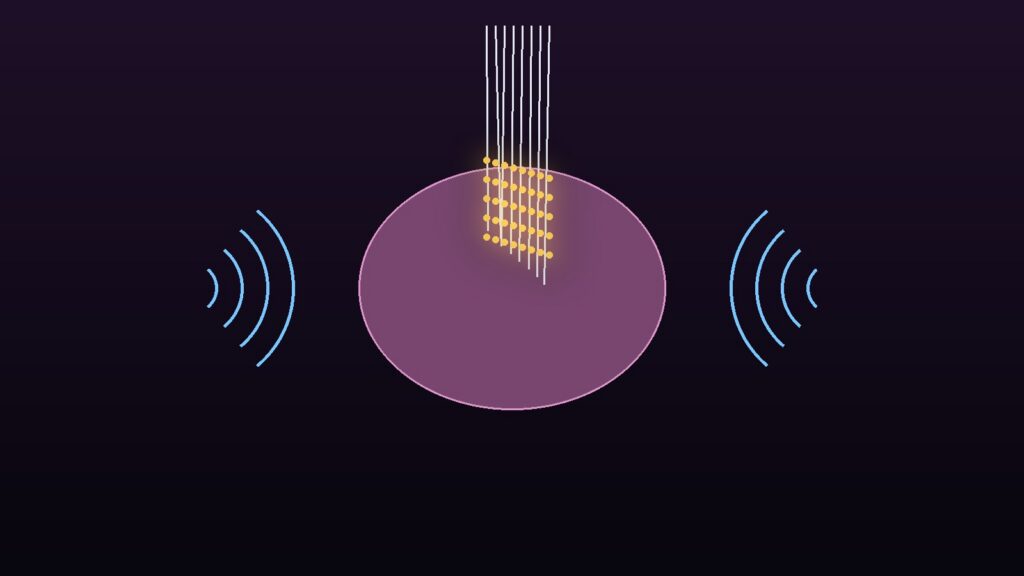
The group built a high-density, ultra-flexible penetrating electrode array they call uFINE. In normal-hearing rats it mapped frequency tuning from 0.5 to 32 kilohertz in the cochlear nucleus and in the inferior colliculus, a midbrain hearing station further along the pathway. Stimulating selected sites in the cochlear nucleus evoked responses in the inferior colliculus that closely matched the animals’ natural tonotopy, the ordered map from low to high pitch, with tuning widths comparable to those evoked by tones.
Those responses stayed stable for more than 136 days with minimal gliosis, the scarring reaction that often degrades implants. In a further experiment, daily paired stimulation of the cochlear nucleus and inferior colliculus progressively shifted the response peak toward the targeted site, which the authors interpret as use-dependent plasticity, meaning the brain’s own wiring adapting to repeated stimulation. They conclude that the array enables high-resolution, tonotopically precise and long-term stable stimulation over a broad frequency range with minimal tissue disruption, and describe this as potential, not demonstrated benefit.
What the evidence does and does not show
The measurements are physiological recordings in rats with normal hearing, not deaf animals, and not people. The study shows that stimulation can recreate a tonotopic pattern of activity in the midbrain; it does not show that an animal, let alone a patient, perceived pitch or understood speech. 136 days is encouraging for rodents but far short of the decades a human implant must last, and the brainstem is a hazardous place to implant. Whether penetrating electrodes can be placed safely during tumour surgery is untested in the work we reviewed. We have the abstract and metadata, not the full text, and found no independent replication or clinical trial registration.
Winners, losers, money and people
If the approach reaches the clinic, patients with neurofibromatosis type 2 and others ineligible for cochlear implants would be the main beneficiaries, along with whichever implant makers license or build such arrays. Makers of established surface-electrode devices would face a technology gap, although regulatory approval for a penetrating brainstem device would take many years.
The author list begins Jinxi Pan, Bodi Liu, Zeyu Wang and Guangyuan Chen and ends with Hao Wu; the affiliations include the hospital’s otolaryngology department, the Ear Institute and the Shanghai Key Laboratory of Translational Medicine on Ear and Nose Diseases. Funding disclosures cite the National Natural Science Foundation of China, national key technology programmes and Shanghai municipal projects. The acknowledgements thank Shanghai StairMed Technology Co., Ltd. for assistance with electrode assembly.
Listing check
Shanghai StairMed Technology Co., Ltd. is named only in the acknowledgements for electrode assembly assistance; we found no evidence that it is publicly listed, and its listing status is unverified. Shanghai Ninth People’s Hospital and Shanghai Jiao Tong University are not listed companies. No Trading 212 check applies. Patent publication searches were not completed on this run.