
Oxford researchers report that pressing an egg-box topography into the lithium and sulfide electrolyte interface raises the discharge current at which voids begin tenfold. It is a laboratory result at modest stack pressure and does not remove voiding.
In 1886 the German mineralogist Albin Weisbach named a new silver ore argyrodite, from the Greek for “rich in silver”, after it turned up in the Himmelsfürst mine near Freiberg in Saxony. The same ore gave the chemist Clemens Winkler the element germanium, isolated 15 years after Mendeleev had predicted it. A century and a half later the name has migrated to batteries: the solid electrolyte Li6PS5Cl belongs to a family of lithium “argyrodite-type” materials that researchers regard as promising for solid-state cells.
A paper published online in Nature Energy on 23 November 2026 by a group in Oxford’s Department of Materials, with Peter Bruce as last author, tackles one of the problems that keeps such cells in the laboratory: what happens at the lithium surface when the cell is discharged quickly.
Why it matters
Solid-state batteries replace the flammable liquid electrolyte with a solid, and pairing one with a lithium metal anode could raise energy density. But when lithium is drawn out of the metal on discharge, vacancies can collapse into voids at the interface, the contact falls and resistance climbs. The authors describe interfacial voids formed during discharge as a major barrier to practical lithium metal solid-state cells, one that limits how fast such cells can deliver current.
How it works
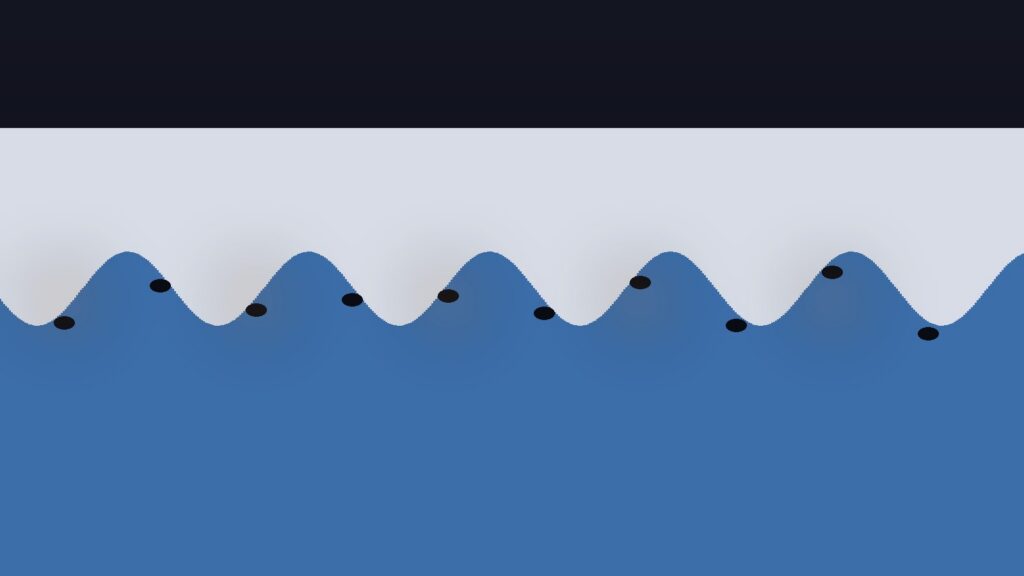
The group introduced an egg-box topography, a regular pattern of peaks and troughs, at the interface between lithium and the Li6PS5Cl electrolyte. They report that this raises the discharge current at which voiding begins tenfold, from 0.2 to 2 milliamps per square centimetre, at 2 megapascals of pressure and 30 degrees Celsius. The contoured interface also sustained pulsed currents of up to 3 mA per square centimetre at 30 degrees and 8 mA per square centimetre at 60 degrees without cell failure.
Crucially, the authors say contouring does not completely eliminate voids. It suppresses their growth and the associated voltage loss. In tests that replayed discharge profiles derived from the Worldwide Harmonised Light Vehicles Test Procedure, a standard driving-cycle benchmark, contoured interfaces sustained them while flat ones failed rapidly. A full cell with a thin contoured solid electrolyte kept the same advantage.
What the evidence does and does not show
These are experimental measurements from one group, reported in a peer-reviewed journal, but we reviewed the abstract and metadata, not the full paper. The conditions are specific: the tests ran at 30 and 60 degrees Celsius, at 2 megapascals, in laboratory cells with a single electrolyte, which is not a battery pack. We could not assess how the pattern would be made at scale, how it survives repeated charge cycles, or what it does to cost; the abstract does not address manufacturing. A driving-profile test is a useful proxy but not a vehicle test. We found no independent replication.
Winners, losers, money and people
If contouring generalises, the gainers are developers of sulfide-based solid-state cells, who need higher discharge rates without heavy stack pressure, and vehicle makers seeking longer range and safer cells. The risk falls on rival approaches that rely on high pressure or interlayers to keep contact, and on any pitch that assumes a flat lithium foil will do. Nothing here changes the market this year.
The author list is Shengming Zhang, Bingkun Hu, Dominic Melvin, Dominic Spencer-Jolly, Xiangwen Gao, Longlong Wang, Lechen Yang, Charles Monroe and Peter Bruce. Bruce acknowledges support from the Faraday Institution (FIRG026), the Engineering and Physical Sciences Research Council and the Henry Royce Institute.
Listing check
No company is named as a party to the paper. The University of Oxford and the Faraday Institution are not listed companies. Companies developing sulfide solid-state cells are context only and are not connected to this study, so no listing or Trading 212 check applies. Patent publication searches were not completed on this run.