
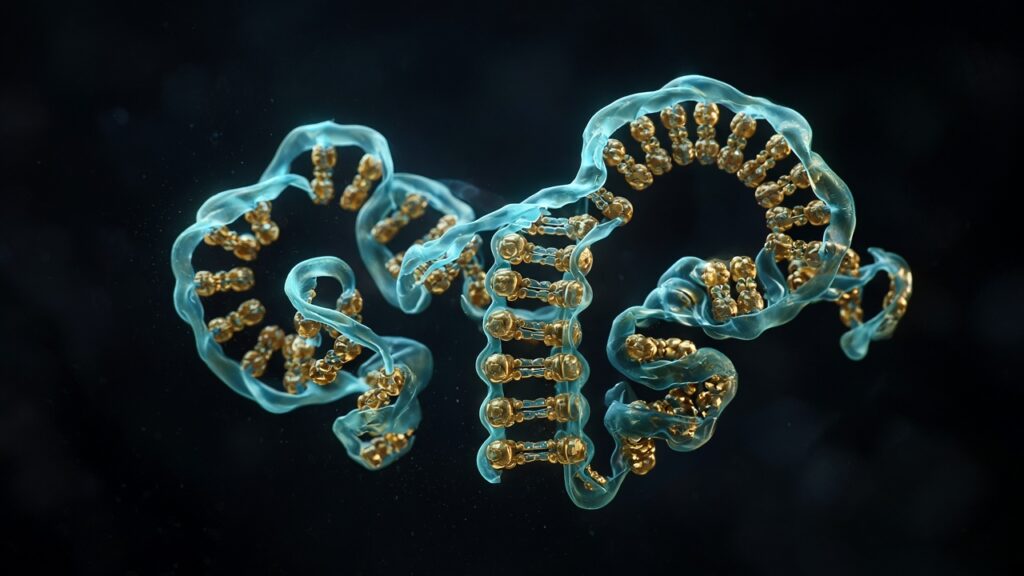
RNA does not spend its working life as a straight line of letters. In cells, and in some viruses, the molecule folds into shapes that decide what it can do, from building proteins to switching genes on and off. A team at the University of Science and Technology of China has released an open model that tries to learn those shapes from the sequence alone.
The model, called structRFM, comes from Professor S. Kevin Zhou and researcher Peng Xiong at USTC’s MIRACLE laboratory, a medical imaging and robotics group in the School of Biomedical Engineering in Hefei. Their paper, “An open structure-guided RNA foundation model for generalizable prediction”, was published in Nature on 4 November 2026. Xinhua reported the release the following day.
Why it matters
Most RNA language models have been trained on sequence: the order of the nucleotides. The difficulty is that function follows fold. structRFM was trained on about 21 million computationally annotated sequence and secondary-structure pairs. The researchers built that set with a method they call MUSES, which combines several ways of predicting secondary structure so that no single predictor dominates the training data. They then folded base-pairing into the pre-training itself, masking paired positions together so the model has to learn sequence context and structural dependence at the same time.
Once trained, the model needs only a sequence. From that it extracts features at three levels: the whole strand, individual nucleotides, and pairs of nucleotides. Those features can be used for structure prediction and for functional tasks.
What the paper claims
In tests reported in Nature, structRFM performed well at zero-shot homology classification and improved secondary-structure prediction. When its features were fed into a tertiary-structure method the team calls Zfold, the paper says both the three-dimensional predictions and the secondary structures taken from them improved. On the CASP15-natural, CASP16 and RNA-Puzzles benchmarks, Zfold’s performance was comparable to AlphaFold3, DeepMind’s general-purpose structure model.
The system also handled splice-site prediction, internal ribosome entry site recognition and the classification of non-coding RNAs, including longer strands approached in segments. It kept useful secondary-structure performance on RNA families released after the training cut-off.
The people and the money
Heqin Zhu, of the School of Biomedical Engineering, is the first author. Zhou and Xiong are joint corresponding authors. The wider author list includes Ruifeng Li, Ao Chang, Haobin Chen, Feng Zhang, Fenghe Tang, Tong Ye, Xin Li and Yunjie Gu. The laboratory has published the paired dataset, the model weights and the source code, including a public repository on GitHub.
This is not a company raising money. USTC said the work was funded by the National Natural Science Foundation of China, the National Key Research and Development Programme, and basic research programmes in Jiangsu and Suzhou. There is no commercial funding round attached to the paper.
Who stands to gain, and who may feel it
The first users are likely to be academic laboratories and smaller drug-discovery groups that cannot train a foundation model of their own. RNA medicines, whether messenger RNA, RNA interference or antisense approaches, depend on knowing not only what a strand says but how it will fold and where it might be spliced or blocked. An open model that is competitive on public structure benchmarks lowers the cost of that first look.
The pressure, if other groups can reproduce the results, falls on closed RNA structure tools and on sequence-only language models that ignore fold. DeepMind’s AlphaFold3 remains the reference point the authors chose for comparison. A freely available specialist RNA model will not replace a full drug programme, but it may change who can attempt the early computational work and how much they have to pay a vendor to do it.
Reproduction will decide how far that goes. The authors have made that test possible by releasing the data and the code.