
Seoul Viosys says it is mass producing white light from gallium nitride alone, with no rare earth phosphor and no package, in chips as small as 10 micrometres. The claim is the company’s own, and the brightness per chip is tiny.
Seoul Semiconductor tells the story of its own technology as a sequence of three awkward questions from its founder, Chung Hoon Lee. Why do semiconductors need packages. Why do LEDs need lenses, and why must they run at about three volts. And then, most recently, why do we need rare earths to produce white light. The company’s technology explainer, published on 2 November, lays out the sequence and notes that Lee, a physicist by training, kept spending about $100m a year on research through difficult trading years.
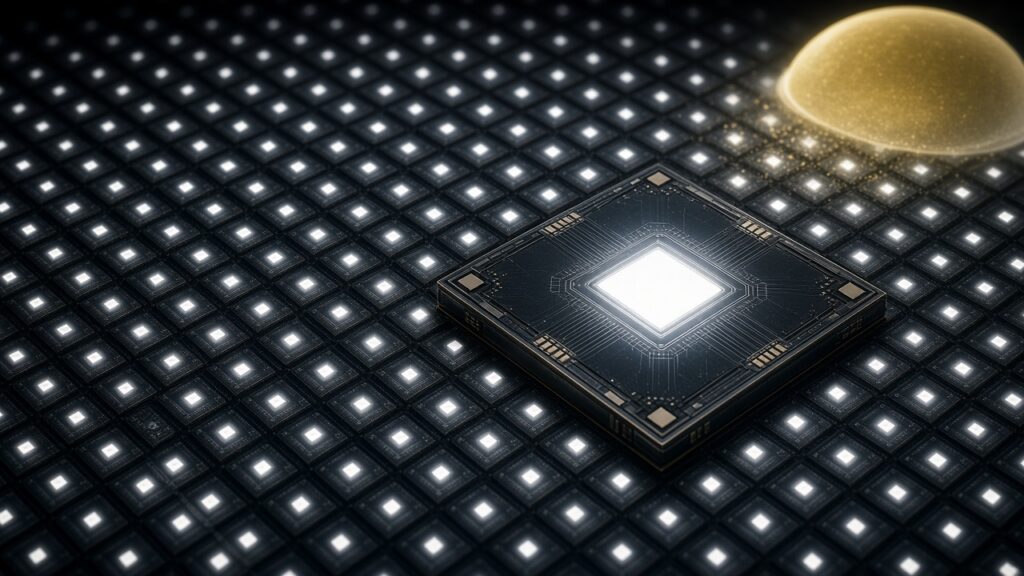
The answer to the third question went into production last month. On 28 October, Seoul Viosys, the group’s opto-semiconductor affiliate, announced mass production of WICOP 3, a chip that it says emits white light without rare earth phosphors, and can be made as small as 10 micrometres.
Why the yellow powder matters
For three decades, a white LED has been a blue LED wearing a coat. A blue gallium nitride chip is covered with a phosphor, most commonly yttrium aluminium garnet, which converts part of the blue light to longer wavelengths so the mixture looks white. Yttrium is a rare earth. The supply chain for rare earths is geographically concentrated and has become a recurring instrument of trade policy, which is why a phosphor-free route is a strategic question and not only a technical one.
The coating also sets a size floor. The company says white chips could not go below 1,000 micrometres because the phosphor and its package had to go somewhere. WICOP, which stands for wafer integrated chip on PCB, removed the package for ultraviolet, blue, green, red and infrared devices under 100 micrometres. White stayed behind. Seoul Viosys says WICOP 3 is the first white opto-semiconductor to reach white light in a micro LED smaller than 100 micrometres, generating white from gallium nitride alone, with no plastics, silicones or lead frames.
Read the performance figures carefully
The first production chip measures 25 by 10 micrometres and produces 0.015 lumens, with chromaticity inside the CIE standard white region. Luminous efficacy is described as close to 100 lumens per watt, with a target of 200 within two years. A conventional chip of 1,000 by 1,000 micrometres produces 50 lumens. The company says the result costs about half as much to make as a conventional white LED.
Those are the developer’s own numbers, published through a corporate newsroom and a Business Wire release and recirculated by the trade press, including Semiconductor Today. No independent measurement, standards body certification or peer-reviewed paper was found in the sources reviewed. Nor do the public materials explain the physical mechanism by which gallium nitride alone produces a broad white spectrum, which is the single most important technical detail and its most conspicuous absence. Efficacy near 100 lumens per watt is respectable but sits well below the best phosphor-converted white LEDs, so this is a trade of raw efficiency for size, materials independence and cost. Colour rendering, which decides whether a light source is usable for general lighting, is not addressed in the materials reviewed. Lifetime claims of decades rest on the absence of organic materials rather than on published ageing data.
Who wins if it holds
Supply is scheduled to begin in the fourth quarter of 2026, and the company says it will supply first those customers who have respected its intellectual property, a pointed remark from a group with a long history of patent litigation in the LED sector. White LEDs account for roughly $10bn of a $15bn packaged LED market on the company’s figures, so even partial substitution is commercially significant.
The obvious beneficiaries would be makers of augmented reality displays and micro LED panels, where a white emitter under 100 micrometres removes a packaging step, and automotive lighting, where Seoul already supplies manufacturers including Tesla. The obvious losers would be phosphor producers and the packaging supply chain, including silicone, lead frame and dispensing equipment vendors. The company is explicitly recruiting partners, and it cites forecasts from research firms including Omdia that micro LED optical interconnects and augmented reality together could create a $60bn market within five years. That figure is a third-party forecast about an adjacent application, not a measure of demand for this chip, and five-year display and interconnect forecasts have a poor record. The claim worth tracking is narrower and testable: whether an independent customer ships a product using phosphor-free white WICOP 3 in 2027, and what efficacy and colour rendering it reports.