
A Fraunhofer team in Potsdam is building a robot platform that produces enzyme variants without living cells, then trains AI on the results. The bottleneck it attacks is real, but the platform is early and the spin-off does not exist yet.
The team behind this project assembled itself through a funding scheme rather than a department. Simon Krebs, a biotechnologist, and Benedikt Dechamps, an industrial engineer, met through AHEAD, a Fraunhofer programme for people trying to start companies. Holly Corbett joined later to lead the artificial intelligence side. Her description of the work, in Fraunhofer’s research news of 2 November, is unusually unromantic for a press release: engineering craftsmanship at a molecular level.
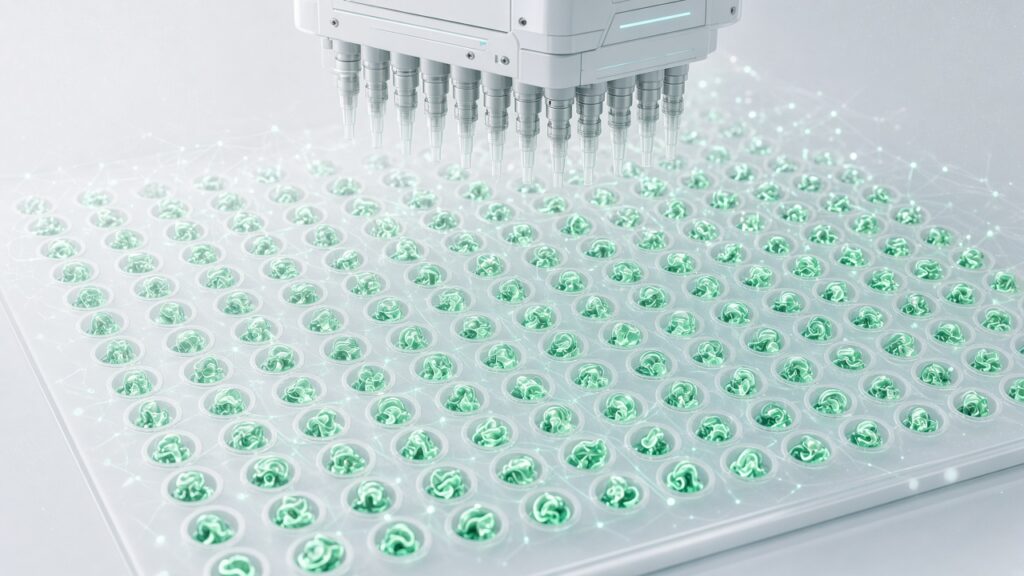
The project is called ZenBio and it sits at the Fraunhofer Institute for Cell Therapy and Immunology, branch bioanalytics and bioprocesses, in Potsdam. The aim is an automated platform that pairs cell-free protein synthesis with AI-assisted enzyme design.
The bottleneck is data, not ideas
Enzymes already do industrial work, making active pharmaceutical ingredients, speciality chemicals, cosmetics ingredients and food products, and they do it at milder temperatures and pressures than conventional chemistry. The difficulty is that an enzyme evolved for the inside of a cell is rarely suited to a reactor that runs hot, acidic or full of organic solvent. Krebs puts it plainly: enzymes are adapted to the organisms they come from, and industrial processes demand something different.
Computational design is supposed to fix this, and partly does, but Dechamps identifies the constraint accurately. AI can only learn from what has been measured. The relationship between sequence, three-dimensional shape and catalytic function is where predictions break down, and there is not enough experimental data on how specific genetic changes alter behaviour to train models properly.
So the platform is built to manufacture that data. Rather than growing cells to make each variant, which takes days and fails outright for variants that living cells cannot fold or tolerate, the team combines the genetic blueprint with a cell extract containing everything needed for synthesis, and the enzyme is produced directly in the extract. Because nothing is alive, the reaction can be shrunk and its conditions tuned freely. The stated goal is a robotic pipetting station producing and analysing up to 1,500 variants of an enzyme in parallel, with temperature, pH and solvent tolerance read out within hours. Each cycle trains the model, which proposes the next batch.
How early this is
Early. Fraunhofer says the first phase of the automated workflow is complete, and that the team will now miniaturise and automate further and test the platform on an initial class of enzymes. The 1,500-variant throughput is described as a future capability. No performance data, no benchmark against existing directed evolution or commercial design platforms, and no named enzyme target appear in the release. There is no peer-reviewed publication accompanying it.
The commercial structure is equally provisional. Funding comes from the German Federal Ministry for Economic Affairs and Energy through its EXIST Research Transfer programme, which exists to move academic work towards company formation. The team plans pilot projects with industrial clients and intends to establish a spin-off named ProEvo. Intends is the operative word. No incorporation, funding round, valuation or client was identified in the sources reviewed, and the amount of the EXIST grant is not stated in the release.
Why it is still worth watching
Three things make this more than routine institute publicity. First, the diagnosis is correct and widely shared: the industry’s constraint on machine-designed proteins is the scarcity of clean, consistent sequence-to-function data, which is why several well-funded firms are building high-throughput wet laboratories alongside their models rather than relying on public databases. Second, cell-free synthesis is a genuinely good instrument for that specific job, because it tests variants that living cells refuse to make, and those failures carry information that cell-based screens never generate. Third, Fraunhofer’s institutional position means the output is likely to arrive as a service to European chemical and pharmaceutical manufacturers rather than as another model seeking a business.
If it works, the beneficiaries are speciality chemical and pharmaceutical producers that want a bespoke biocatalyst without running their own protein engineering group, and the laboratory automation and cell-free reagent suppliers that sell the picks and shovels. The parties under pressure would be contract research organisations offering conventional directed evolution on cell-based timescales. These are reasoned scenarios rather than announced arrangements. The risks are ordinary and serious: cell-free extracts can behave differently from the production organism that will eventually have to make the enzyme at tonne scale, miniaturised assays do not always predict reactor performance, and a spin-off competing with well-capitalised protein design companies will need either a defensible data asset or a narrow, defensible niche. The milestone to watch is the first named enzyme class with published numbers, and whether ProEvo is actually incorporated.