
Engineers at the University of Edinburgh and Michelin built tidal turbine blades from rubber moulded around a steel spar. In tank tests the blades matched the energy yield of rigid blades with active pitch control while cutting fatigue-driving load swings by up to 29 per cent, and they did it with no motors, sensors or bearings.
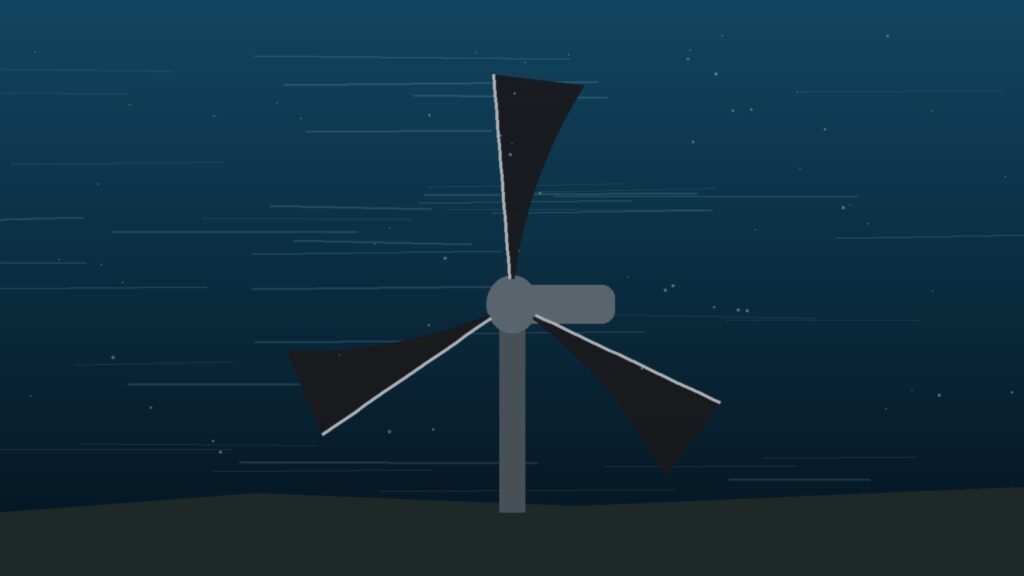
The most expensive part of a tidal turbine is often the part that exists only to stop the turbine destroying itself. Large machines carry pitch control: motors, bearings, sensors and seals that twist each blade out of the flow when the current runs too hard. It works, it is costly, and it sits underwater in one of the most hostile places an engineer can put a mechanism. A paper published in Nature on 11 November 2026 by a team from the University of Edinburgh and the tyre maker Michelin proposes removing it and letting the blade bend instead.
Why it matters
Tidal stream power has one advantage no other renewable can claim: the resource is astronomical, so output can be forecast years ahead. The paper puts the European resource at about 50 terawatt hours a year and the United States resource at as much as 220, with the United Kingdom targeting 1 gigawatt of installed tidal stream capacity by 2035 and international roadmaps sketching more than 300 gigawatts worldwide by 2050. What has held the sector back is not physics but arithmetic: turbulence, waves, velocity shear and the wakes of neighbouring machines hammer the blades with fluctuating loads, which forces heavy structures, short maintenance intervals and a levelised cost of energy that cannot compete.
Active pitch control manages the slow part of that problem, the tidal cycle itself. It is poor at the fast part. Actuators cannot respond at the frequency of a blade revolution, which is exactly where the turbulence-driven fatigue damage comes from. So the industry pays for a mechanism that solves half the problem and adds a new failure mode.
How it works
The Edinburgh and Michelin blade keeps a rigid leading edge, a steel spar running from root to tip, and makes the trailing edge flexible along the whole span. The blades were manufactured by injecting a proprietary rubber mixture into a mould around that spar, and the stiffness is tuned along the span by varying the ratio of spar width to chord. As the current strengthens, the trailing edge deflects and flattens the camber of the aerofoil, so the blade sheds load by changing shape. The team calls this chordwise flexibility, as opposed to the spanwise bending studied in aeroelastic tailoring for wind blades.
Crucially the deformation is passive and instantaneous. There is nothing to command, nothing to power and nothing to seal. The authors designed the stress-free mould shape with a bespoke fluid-structure interaction solver that couples blade element momentum theory, a panel method with an integral boundary layer, and finite element analysis, so that the blade relaxes into the reference rigid geometry at the design flow speed and tip-speed ratio.
What they measured
Testing used a three-bladed horizontal-axis turbine of 1.26 metre rotor diameter in the FloWave Ocean Energy Research Facility at Edinburgh, a 25 metre circular wave and current basin, run in current-only mode at a water depth of 1.92 metres and six inflow speeds between 0.444 and 0.923 metres per second. Turbulence intensity in the tank is 8 to 9 per cent, close to the 5 to 11 per cent measured at the Fall of Warness tidal site in Orkney. One set of rigid stainless steel blades served as the baseline and three sets of rubber blades of different stiffness were compared against it.
Combining the measurements with a simulated tidal cycle, the rubber blades with a simple speed controller produced normalised power curves that coincide with those of a rigid turbine using state-of-the-art active pitch and speed control, so the total energy yield is effectively the same. The standard deviation of the high-frequency load fluctuations, the component that drives fatigue, fell by up to 29 per cent, which the university release rounds to one-third. Because rubber has a density close to that of water, the blades can be made close to neutrally buoyant, which further damps load variation. Simulations of a 20 metre diameter machine rated at 3 metres per second, matched to the model tests through the Cauchy number, reproduced the model-scale power and thrust coefficients, and a preliminary calculation in the supplementary material suggests a full-scale rubber blade would comfortably exceed the 20 year service life expected of current turbines.
Who gains and who loses
If this survives scaling, the losers are the suppliers of underwater pitch systems: actuator, bearing, slip-ring and subsea seal vendors whose content per turbine would largely disappear. The winners are developers of tidal arrays, whose capital and maintenance costs both fall, and whoever can mould large elastomer structures to tight aeroelastic tolerances, a capability that sits with tyre and industrial rubber manufacturers rather than with composite blade shops. Michelin is a co-funder and co-author here, and Bertrand Daval of Michelin is a corresponding author alongside Ignazio Maria Viola of Edinburgh, which tells you how the company sees the adjacency. The same trailing edge trick is explicitly framed by the funding line as applying to wind as well as tidal blades.
Caveats
This is a 1.26 metre rotor in a tank. The full-scale claims rest on simulations with the authors own solver, and the fatigue life estimate is a preliminary calculation, not a tested result. Rubber in seawater over two decades brings its own questions: biofouling, abrasion by suspended sediment, bonding between rubber and the steel spar, creep, and the behaviour of a proprietary compound no one outside Michelin can yet characterise. Energy yield equivalence was shown over a simulated tidal cycle, not over a year in a real channel. No cost figures are published. And passive control gives up something active pitch offers, namely the ability to feather the rotor deliberately, for example to shut down in extreme conditions or to start up under load.
Funding, people and listing note
Zhehong Zhang, Junchen Tan, Eric-Carin Neba, Sylvain Morival and Kuba Frankowski contributed equally. The Edinburgh authors are in the School of Engineering, Institute for Energy Systems; Neba, Morival and Daval are at Manufacture Francaise des Pneumatiques Michelin in Clermont-Ferrand; Viola also holds affiliations at the University of Bologna and Tsinghua University. The work was supported by Michelin under a project titled Flexible trailing edges for tidal and wind turbines, Phase 2, and by the Engineering and Physical Sciences Research Council Centre for Doctoral Training in Wind and Marine Energy Systems and Structures (EP/S023801/1), with FloWave measurement equipment funded under EP/X035174/1. Listing note (checked 13 November 2026): the University of Edinburgh is a public body and is not listed. Compagnie Generale des Etablissements Michelin SCA is listed on Euronext Paris as ML, ISIN FR001400AJ45, and Trading 212 has an Invest instrument page for ML on Euronext Paris, so UK investors can in principle hold the shares directly rather than only as a contract for difference, subject to what their own account offers. That is exposure to a tyre maker with revenues measured in tens of billions of euros, not to this blade. This is not investment advice.