
A University of Toronto-led team, with co-authors at Shell, has run a combined carbon-capture-and-conversion cell for more than 1,000 hours by designing a cobalt catalyst that stabilises after shedding about half its cobalt. The test was in a laboratory cell, and energy efficiency remains modest at 39 per cent.
The author list of a paper published in Nature Energy on 30 October runs to 35 names and reaches from a synchrotron in Hsinchu to Shimane University in Matsue, on Japan’s Sea of Japan coast, and to Shell Global Solutions International in Amsterdam. Its central finding is counter-intuitive: a catalyst that loses roughly half of its active metal in the first hours of use and then stops degrading.
Why it matters
Turning carbon dioxide into useful chemicals with low-carbon electricity is one way to cut emissions from chemical and fuel production. The usual route is expensive: capture CO2 in a solvent, heat the solvent to release pure gas, then feed it to an electrolyser. “Reactive capture” skips the heating step by converting the CO2 while it is still bound in the capture solution. The paper’s abstract notes that “existing systems show poor durability”, which is the difference between a laboratory demonstration and an industrial process. Carbon monoxide, the product here, is a building block for synthetic fuels and chemicals.
How it works
The team, led by David Sinton in the University of Toronto’s Department of Mechanical and Industrial Engineering, first worked out why these cells die. During operation, the pH swing that defines reactive capture drives protons towards the cathode, creating an acidic pocket that strips metal atoms out of molecular catalysts. In comparison tests summarised by Research Pop, a silver catalyst declined after about 8 hours, nickel phthalocyanine after about 20 and a standard cobalt phthalocyanine after about 90.
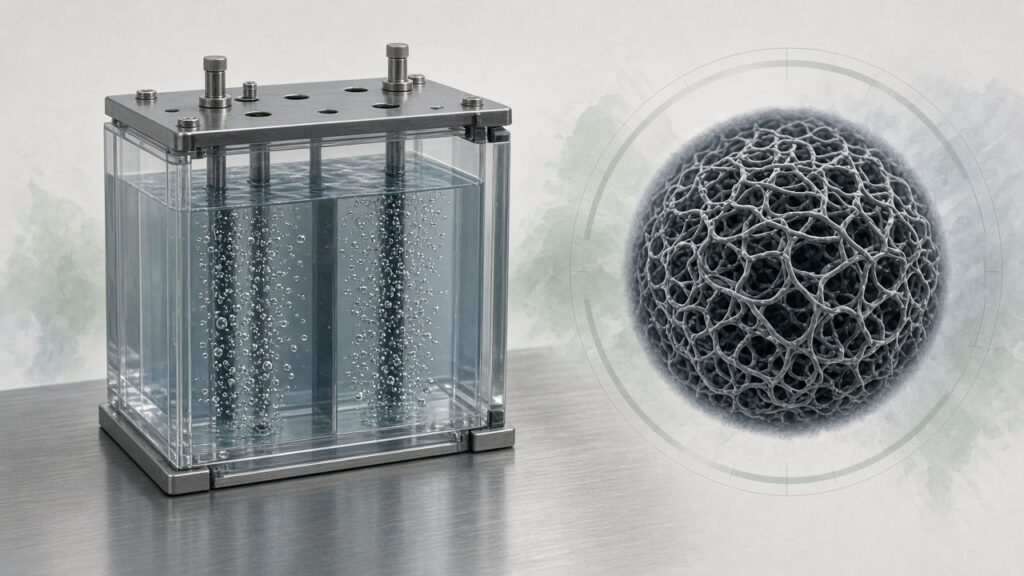
The answer was to link cobalt phthalocyanine molecules covalently into a network on carbon nanotubes. In that network, the early loss of about half the cobalt leaves vacancies that cause neighbouring cobalt sites to contract, shortening and strengthening their bonds to nitrogen. The remaining sites then resist further attack. The authors call it a self-reinforcing vacancy network.
The reported result is continuous operation for more than 1,000 hours, roughly six weeks, at 50 milliamps per square centimetre, with about 80 per cent of the current going to carbon monoxide and an energy efficiency of 39 per cent at 2.9 volts. At higher currents the demonstrated runs were shorter: about 530 hours at 100 and 280 hours at 200 milliamps per square centimetre. Ad Fontes compares this with a 2024 reactive-capture test at the same current density, which it says ran for about one-thirtieth as long with 64 per cent selectivity and 31 per cent energy efficiency.
Who gains and who loses
Durability is what operators of chemical plants and carbon-capture projects pay for, so a credible route to longer-lived molecular catalysts would interest firms that already capture CO2 and want an outlet for it other than storage, and producers of synthetic fuels who need cheap carbon monoxide. Shell’s participation through its research arm suggests industrial interest, though the paper does not announce any commercial programme. Silver-based catalysts, the incumbent choice for CO2-to-CO conversion in many systems, would face a cheaper cobalt alternative if the results translate to large cells.
Caveats
All figures come from laboratory cells. An energy efficiency of 39 per cent is low for an industrial process, and Research Pop reports an energy requirement of about 27 gigajoules per tonne of carbon monoxide, a figure that would need to fall for the economics to compete with fossil production. Larger electrodes, thousands more hours of operation and a full cost assessment are still needed. The 1,000-hour figure applies only at the lowest current density tested. The mechanism is supported by spectroscopy and calculations from the authors’ own team and has not been independently replicated.
Funding, people and listing note
Zunmin Guo of Toronto and Feng Li of the University of Queensland’s UQ Dow Centre are co-first authors; Sinton, Rui Kai Miao and Sung-Fu Hung of National Yang Ming Chiao Tung University are corresponding authors. Other partners include the University of Manchester and Kaohsiung Medical University. Listing note (checked 12 November 2026): Shell Global Solutions International B.V. is not itself listed; it belongs to the Shell group, whose parent Shell plc is listed on the London Stock Exchange as SHEL (ISIN GB00BP6MXD84) and on Euronext Amsterdam. Trading 212 lists Shell plc shares on its Invest instrument pages, but that gives only indirect exposure to a very large energy company, not to this catalyst, and availability in any individual account was not checked. This is not investment advice.