
Beijing researchers have made an injectable gel that flows through an endoscope, sets in about 30 seconds at body temperature and sticks only on the side facing tissue. It closed stomach fistulas in rats and pigs, but has not been tested in people.
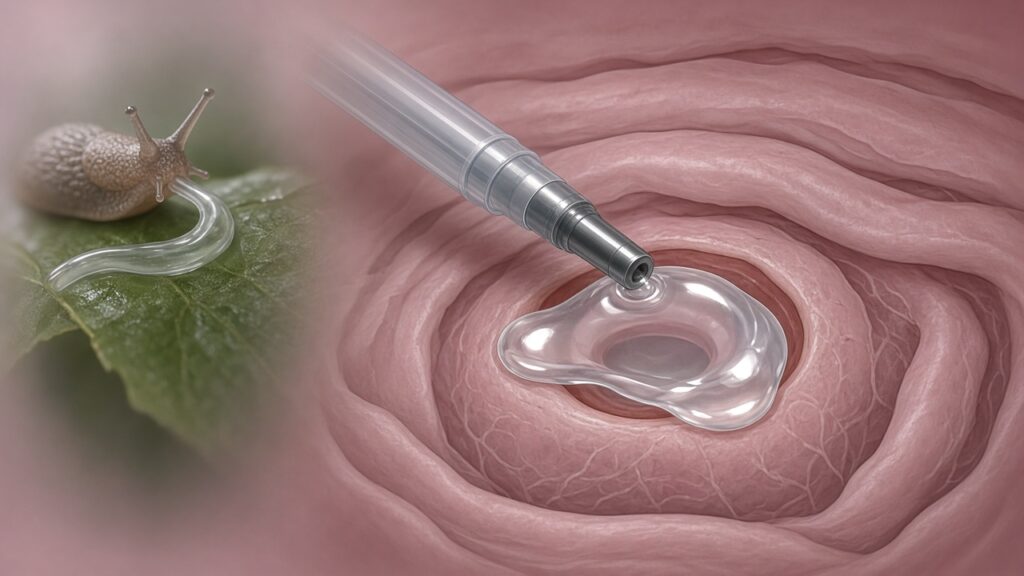
In humid forests, some slugs defend themselves with a mucus strong enough to glue a tree frog to a branch, according to the Chinese Academy of Sciences. The secret is a mix of positively charged proteins that grip wet, negatively charged surfaces and tangle into a gel when metal ions and the surroundings change. That detail caught the attention of Bai Shuo at the academy’s Institute of Process Engineering in Beijing, who wanted something that could stick to the inside of a leaking stomach without sticking to everything else.
The result, developed with Li Jingtao’s team at the China-Japan Friendship Hospital and published in Nature Biomedical Engineering on 30 October, is a gel the researchers call PGa III. It targets gastrointestinal fistulas, abnormal channels between the digestive tract and another organ or tissue that can follow surgery, trauma, inflammatory bowel disease or cancer, and can be life-threatening. Current endoscopic fixes all have drawbacks, the institute says: stents migrate, fistulas closed with titanium clips can reopen, and endoscopic suturing is technically demanding. Scar tissue that binds neighbouring organs together after surgery complicates matters further.
Sticky on one side only
The sealant combines a temperature-sensitive polymer, poly(N-isopropylacrylamide), with gallium ions. At 25C it is a clear liquid that passes through a fine 27-gauge needle and a standard endoscope channel. At body temperature it turns to gel in about 30 seconds. The side touching tissue grips through electrostatic attraction and molecular entanglement, while the side facing the inside of the gut stays slippery. In laboratory tests the adhesive face reached a shear strength of about 10.46 kilopascals against 0.11 on the other face, a difference of nearly 100-fold.
Two other properties set it apart from earlier injectable glues. As it warms, the gel expels water and contracts, shrinking its surface area by about 51.6 per cent and pulling the edges of the hole inwards rather than swelling and stretching them. Its adhesion and burst pressure rose after soaking in simulated stomach acid at pH 1.0, while those of a commercial fibrin glue fell sharply. The gallium also interferes with bacterial iron metabolism, giving about 98.6 per cent inhibition of E. coli and Staphylococcus aureus in tests.
The animal results
In a rat model of gastric fistula, the researchers report postoperative mortality of 3.3 per cent with the gel, against 6.7 per cent for sutures and 56.7 per cent for fibrin glue, with almost no adhesions and near-complete healing of the stomach wall by day 21. In Bama miniature pigs, a 20-millimetre gastric fistula sealed endoscopically with the gel had closed completely after 14 days, with smooth mucosa and better repair than titanium clips and no visible residue, according to the institute’s summary.
These are small preclinical studies run by the developers, and the comparisons were chosen by them. The institute itself notes that further research is needed to establish safety and efficacy in people. Bai said the team would next study how gallium is metabolised and cleared in large animals, how swings in gut acidity affect the gel’s breakdown, and how to improve the catheter delivery system and manufacturing. Gallium compounds have medical uses, but long-term exposure from an implanted gel would need careful study before any regulator approves it.
Who would care
If the results translate to patients, a single-step injectable sealant could shorten procedures, reduce the need for highly skilled endoscopic suturing and make fistula repair possible in smaller hospitals. That would matter most to gastroenterologists and surgeons treating post-operative leaks, and to health systems that bear the cost of long hospital stays when fistulas fail to close. Makers of endoscopic clips, stents and surgical sealants would face a new competitor, although any product is years away and would need clinical trials in China, Europe or the United States. The approach also hints at broader uses, from sealing fistulas in other organs to designing one-sided adhesives that prevent organs sticking together after surgery.
Listing note: the work comes from a state research institute and a public hospital, with no company named as a partner or licensee in the public materials, so there is no listed company exposure to report.