
Three people with drug-resistant epilepsy had seizures fall by an average of 92.6% after a virus made their neurons sensitive to a pill. One patient stopped taking the pill, and the seizures came back.
The most persuasive result in this trial was an accident. The third patient interrupted the daily pill without planning to, and two seizures followed. When the drug was resumed, the seizures stopped again and did not return for the rest of the follow-up. That sequence, recorded in the account published by Capital Medical University on 5 November, is the clearest evidence in the study that the drug and the gene were working together rather than something else being responsible.
The study was published in the New England Journal of Medicine on 5 November by a team at Xuanwu Hospital of Capital Medical University in Beijing, working with the Chinese Institute for Brain Research and a company called GenAns Biotechnology. Professor Zhao Guoguang is the corresponding author and Professor Luo Minmin of CIBR a co-senior author. Nature’s news report appeared the same week.
How a dimmer switch works in a brain
All three participants had temporal lobe epilepsy with hippocampal sclerosis on one side, scarring in the brain region that also does much of the work of memory. They had lived with epilepsy for between 10 and 25 years and had stopped responding to at least two anti-seizure drugs. The conventional option is surgery to remove the affected hippocampus, which removes the seizures and some of the memory with them.
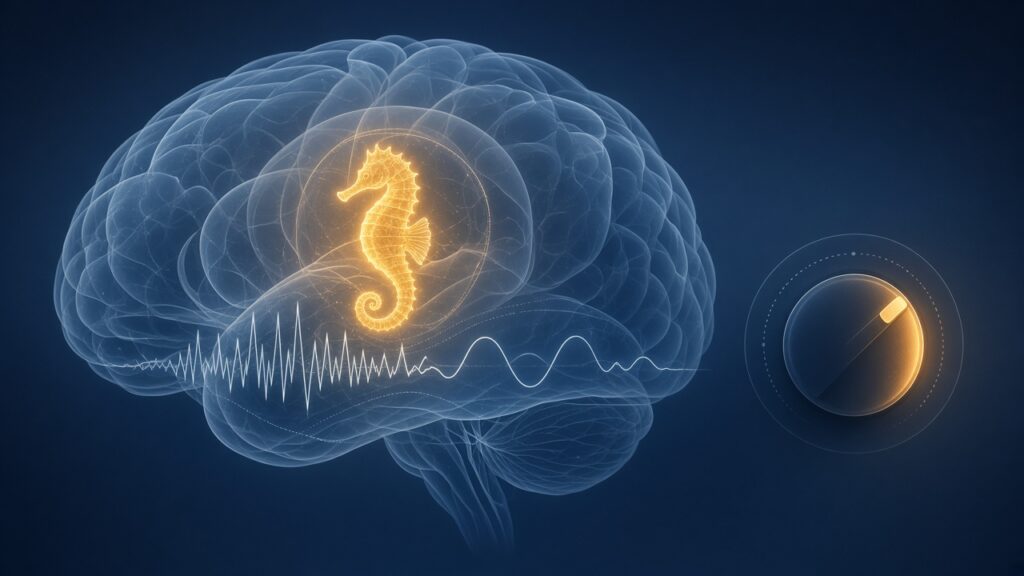
Instead, a vector called GA002, built on adeno-associated virus 9, was delivered into the epileptogenic hippocampus under MRI guidance using convection-enhanced delivery with robotic assistance. The gene it carries makes excitatory neurons produce an engineered inhibitory receptor, hM4Di, that responds to clozapine. Clozapine is an old antipsychotic. Two weeks after surgery the patients began taking it at low dose, every eight hours, alongside their existing medication. The receptor does nothing without the drug and the drug does little to an untreated brain, so the pill becomes a volume control over one patch of tissue.
The numbers and their limits
Between the fifth and twelfth week after surgery, monthly seizures fell by an average of 92.6%. Two patients went from 4.5 a month to 0.5, and the third from 4 to none, with seizure severity scores and interictal spikes on video EEG also falling. Adverse events were grade 1 or 2. One patient had an asymptomatic rise in liver enzymes that resolved without intervention, and cognitive testing found no clinically meaningful decline. Follow-up stands at 12 months for the first patient and 8 months for the other two.
The restraint belongs in the same paragraph as the result. Three people is not a trial that establishes efficacy, and the authors designed it around safety, so there was no control group. Matthew Walker, a neurologist at University College London who was not involved, told Nature that there might be other explanations for the improvement and that it is not clear whether the benefit came from the gene therapy, from clozapine, or from the combination. The unplanned interruption is suggestive on that point but it is one episode in one person. Walker also flagged long-term clozapine use, since high doses carry cardiovascular and other risks, and said better drugs are needed for this kind of switch. He co-founded Focalis Bio, a British start-up also developing gene therapies for epilepsy, which is worth noting when reading his assessment. The trial was registered retrospectively with the Chinese Clinical Trial Register, which is a weakness in the record even though ethics approval is dated January 2025.
Why investors should pay attention anyway
Roughly 30% of people with epilepsy are not adequately controlled by drugs, and that population has been a difficult market for decades, served mainly by surgery and by implanted neurostimulators. A controllable biological treatment would compete with both. The commercially interesting part is not this indication alone but the control mechanism. Conventional gene therapy is a single irreversible dose. A chemogenetic system can be turned up, turned down or stopped, which changes the risk profile that regulators and clinicians weigh, and it creates a durable second revenue line in the activating drug.
Plausible beneficiaries include AAV manufacturers, firms developing cleaner activator molecules to replace clozapine, and the surgical robotics and convection-enhanced delivery suppliers that make precise intracranial dosing routine. Device makers selling neurostimulation for refractory epilepsy face the clearest long-term competitive question. These are reasoned scenarios, not announced deals. The practical hurdles are substantial: manufacturing AAV at scale is expensive, brain surgery limits the addressable population, immune responses to AAV can preclude redosing, and the regulatory path for a two-component therapy where a generic drug is the activator has barely been mapped. The team says it will continue long-term safety follow-up and run a larger study, which is the only thing that will settle whether 92.6% survives contact with a control group.