
A NIST and University of Colorado team reports in Nature a device-independent quantum position verification demonstration that localised a party 2.47 times more tightly than the best classical method.
In late 2015 a group at the National Institute of Standards and Technology (NIST) in Boulder, Colorado, sent entangled photons to two widely separated detection stations on its campus and reported one of the first loophole-free Bell tests, a demonstration that nature really does behave with the strange correlations that Albert Einstein disliked. The physicist Lynden Shalm was the paper’s lead author. Eleven years later Mr Shalm is again the corresponding author on a Nature paper from Boulder, and this time the Bell test has a practical job: proving where someone is.
The study, published on 18 November 2026 with co-authors at the University of Colorado Boulder, Oak Ridge National Laboratory, the University of Maryland, the University of New Orleans and Concordia University in Montreal, introduces and demonstrates what the team calls the Bell-test quantum position verification protocol.
The problem
Much of modern infrastructure trusts claims about location. Satellite navigation, timing networks, authentication systems and financial platforms routinely assume that a signal comes from where it says it does. Classical methods of proving position can be spoofed, because a well-equipped adversary can relay or forge signals from somewhere else.
Quantum position verification has been studied in theory for well over a decade as a remedy, but the authors note that earlier schemes either relied on trusting the quantum hardware, which can be compromised, or required quantum computers and assumptions about the adversary’s computing power. Their approach is device-independent: security rests only on correlations observed in a loophole-free Bell test across a quantum network, not on trusting the equipment.
What they showed
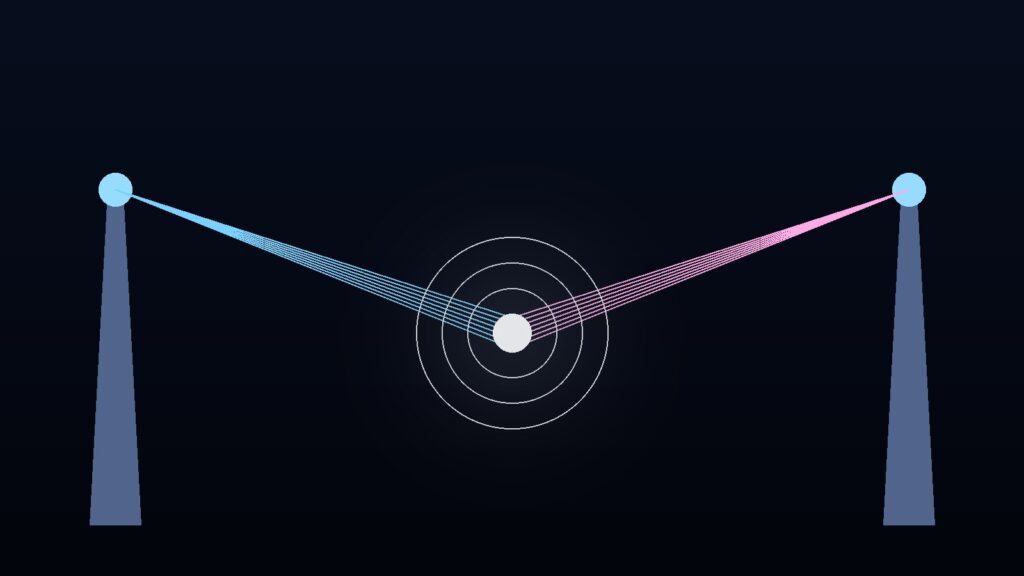
The core idea exploits timing and the speed of light. Verifiers at known locations send signals to a prover who claims to sit at a particular point. Only someone genuinely at that point can respond fast enough to produce the right quantum correlations; someone elsewhere would have to cheat in a way the Bell statistics expose.
In the experiment the team achieved a one-dimensional localisation 2.47 times smaller than the best classical protocol, which in the classical case cannot be done remotely. Compared with classical protocols with identical latencies, the localisation volume was 4.53 times smaller, which the authors describe as a certifiable quantum advantage. The figures in the paper carry quoted statistical uncertainties of a few hundredths.
The important limitation
The authors are explicit that their demonstration was against adversaries who were only weakly entangled before each trial. The full protocol is described as loss-tolerant and secure against adversaries with substantial quantum resources, but that broader security is a theoretical result; the experiment tested a restricted case. Loophole-free Bell tests also remain demanding, requiring highly efficient single-photon detectors and careful timing over separated sites.
Who might care
The paper names financial transactions, legal agreements and protection of critical infrastructure as potential applications. Plausible beneficiaries over the long term include operators of timing and navigation infrastructure, defence and government networks, and the small number of companies building quantum networking equipment and superconducting single-photon detectors, several of which emerged from national laboratories. Vendors of conventional location-authentication services would face a new kind of competitor only if the hardware became far cheaper and more portable than a laboratory Bell test is today.
A practical comparison is quantum key distribution, which has been commercially available for years but has spread slowly because of cost and distance limits. Position verification is at an earlier stage still.
People and funding
NIST is a US federal agency, and the work involves its Boulder laboratories and the joint institutes it runs with universities. Funding details are in the full paper. No company is listed among the authors’ affiliations.
Caveats
This is a peer-reviewed physics demonstration, not a product. The quantum advantage is measured relative to specific classical protocols under the paper’s assumptions. Real-world deployment would require integration with existing networks, practical distances and an answer to the stronger adversaries the experiment did not test.
Company and listing note: all institutions are government laboratories or universities; no company is involved, so no listing or Trading 212 check applies.