
Researchers led by Li Xianfeng at the Dalian Institute of Chemical Physics have made tin switch reversibly between its four-plus and metallic states in a flow battery by adding iodide to the electrolyte. A tin-bromine cell reached 89 per cent energy efficiency and 205 watt-hours per litre of anolyte, and a kilowatt-scale stack ran for more than 1,000 hours.
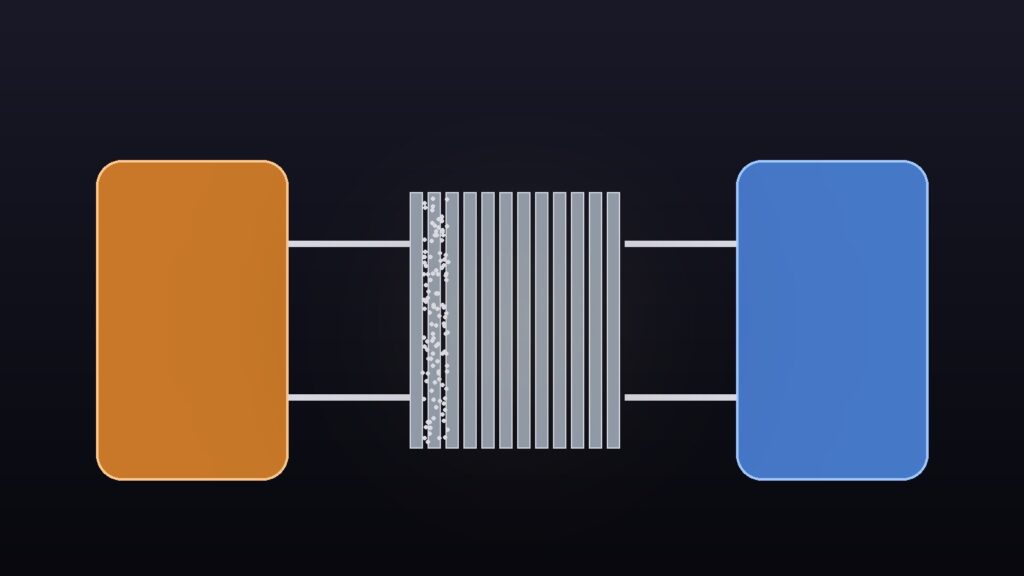
The world’s largest flow battery took six years to connect. The 100 megawatt, 400 megawatt-hour vanadium station in Dalian, built by Rongke Power on technology from the Dalian Institute of Chemical Physics (DICP), was connected to the city’s grid in 2022 after some six years of work, according to the institute and China’s energy storage alliance. It proved flow batteries could work at utility scale. It also showed their handicap: storing energy in tanks of dissolved vanadium takes a lot of liquid and a lot of space.
The same institute’s energy storage division, led by Li Xianfeng, now reports a chemistry aimed at that weakness. In Nature Chemistry, published online on 9 October 2026, first author Yue Ao and colleagues from DICP, the Institute of Chemistry in Beijing, Wuhan University and Jilin University describe a tin anode that cycles reversibly between tin(IV) and tin metal, a four-electron process.
Why it matters
Long-duration storage is becoming a bottleneck as grids add solar and wind. Flow batteries are attractive for it because power and energy can be scaled separately, they do not burn like lithium-ion cells and they last many years. But low energy density raises cost per kilowatt-hour through tanks, pumps and land. Tin is a widely traded industrial metal, very soluble as a chloride and does not grow dendrites, the needle-like deposits that short-circuit zinc and lithium cells. Unlocking all four of its electrons per atom would pack far more charge into each litre of anolyte.
How it works
The obstacle was the step from tin(IV) to tin(II), which is sluggish and largely irreversible in chloride solution. The team’s fix is a mixed-halide electrolyte. Adding iodide to concentrated tin tetrachloride forms two complexes: SnI62-, which lowers the energy needed to rearrange the molecule during electron transfer and so makes the reaction reversible, and SnCl62-, which keeps the tin highly soluble. The gap between the oxidation and reduction peaks fell from 978 millivolts in chloride alone to 97 millivolts with iodide, the paper reports.
Paired with a bromine positive electrode, a full cell achieved 89 per cent energy efficiency at 40 milliamperes per square centimetre, an anolyte capacity of 227 ampere-hours per litre and an anolyte energy density of 205 watt-hours per litre. The authors then built a kilowatt-scale stack that operated stably for more than 1,000 hours.
Caveats
The energy density figure applies to the anolyte only, not to the whole system with both tanks, pumps and stack, so it is not directly comparable with quoted figures for complete batteries. Bromine is corrosive and toxic and needs careful containment, a problem that has hampered zinc-bromine systems for decades. Plating tin metal also means the anode’s capacity is tied to the electrode area and the plated layer’s stability over years of cycling, and 1,000 hours is short against the 20-year lives claimed for vanadium plants. No cost analysis or commercial partner for this chemistry is set out in the abstract or the institute’s public summaries we reviewed.
Who stands to gain or lose
DICP’s track record of carrying flow chemistry from the bench to a 100 megawatt plant gives this work more weight than a typical laboratory claim. If a tin-based system proves durable, developers of long-duration storage gain a denser, potentially cheaper option, and tin producers a new market. Vanadium electrolyte suppliers would face a challenger, though vanadium’s long field record will not be displaced quickly. Our recent coverage of a four-electron iodine water battery from UCL shows the same pursuit of more electrons per atom in safe, water-based chemistries.
Listing and Trading 212 check
The Dalian Institute of Chemical Physics, the Institute of Chemistry, Wuhan University and Jilin University are state research and teaching organisations and are not listed. No company is party to the paper. We did not verify the ownership or listing status of Rongke Power, mentioned here only as the builder of the Dalian station, so no Trading 212 check was made for it. This is not investment advice.